Vipassana in Nepal: a short history
From a 1975 course at the Indian border to 20 centres in all seven provinces: how the Goenka and Mahasi traditions of Vipassana took root in Nepal.
Vipassana Nepal team · · 8 min read
Vipassana courses have been held for Nepalis since 1975, first across the border in India and from 1981 in Kathmandu. Most of the story is told by the organisations themselves, above all the Vipassana Research Institute (VRI) and dhamma.org, and where their accounts disagree with each other or with independent scholars, this page says so. It covers the Theravāda background, the arrival of S. N. Goenka's courses, how the centres spread, and the Mahasi-tradition centres that opened alongside them.
The Theravāda revival in the Kathmandu valley
The Kathmandu valley's own Buddhism is the Newar Vajrayāna tradition. Theravāda, the Buddhism of Sri Lanka, Myanmar and Thailand in which both Vipassana lineages taught in Nepal have their roots, was brought in by a revival movement in the twentieth century. The Dutch scholar Ria Kloppenborg, who did fieldwork in the 1970s, describes how most Nepali monks, novices and nuns of that period were initiated by Chandramani, a Burmese monk living at Kushinagar in India, and how many went on to Burma for higher ordination.
The Rana government was hostile. Kloppenborg records the expulsion of monks in 1926, and on 30 July 1944 an order to stop preaching, ordaining and holding ceremonies, after which the monks who refused were exiled. They were allowed back in 1946 after a goodwill mission from Sri Lanka. After the Rana regime fell, King Tribhuvan joined the Vesak Buddha-puja in 1951, and Vesak became a national holiday.
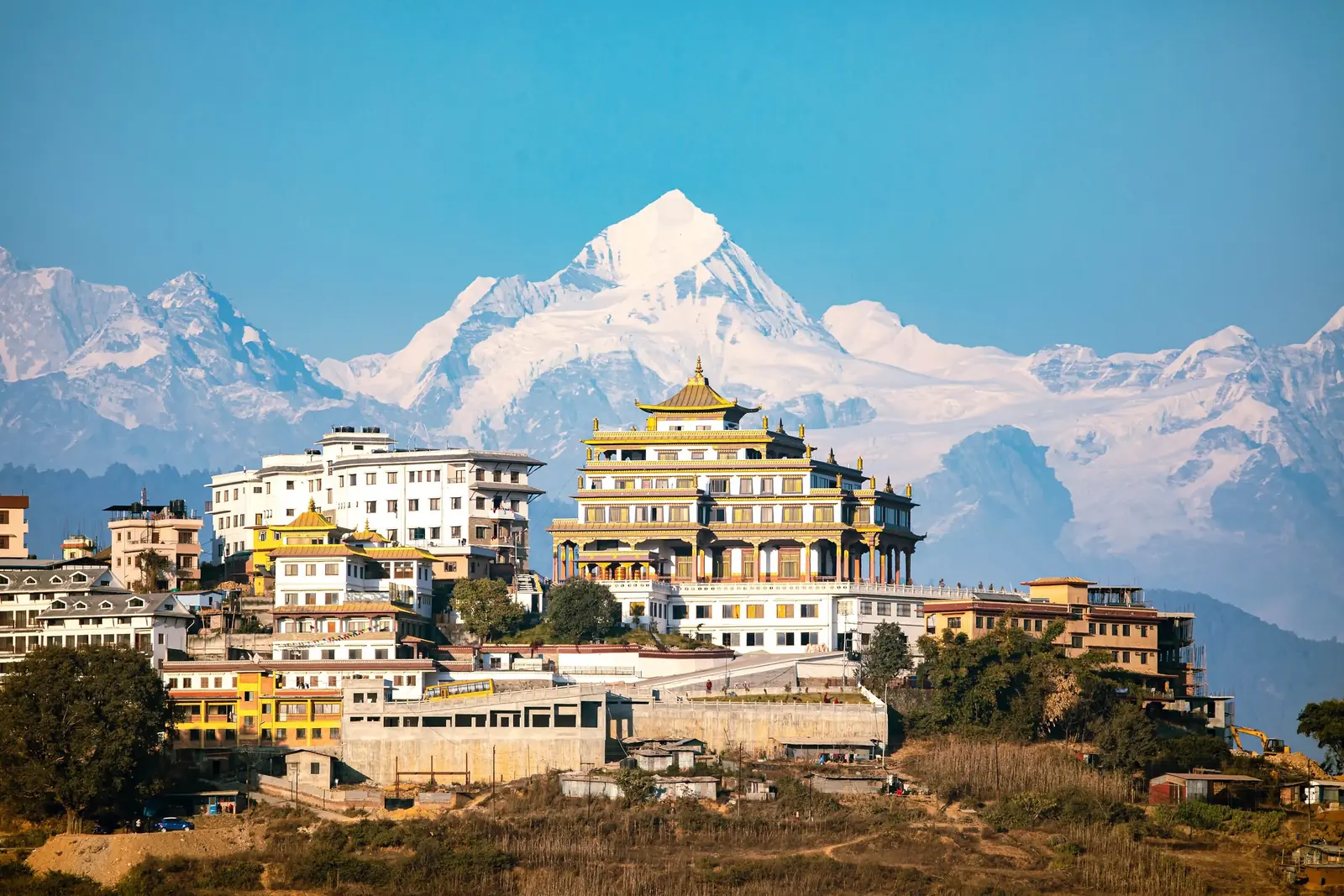
One of the movement's bases was Anandakuti Vihara at Swayambhu. Kloppenborg writes that lay people began building it at the spot where the monk Amritananda used to preach, and calls it one of the main centres of Nepalese Theravāda. It later housed a library founded during the 1946 mission.
Meditation came later. Kloppenborg noted a new interest in Satipaṭṭhāna meditation among a small number of monks, and a Vipassana programme run from 1975 at Gana Mahavihara in Kathmandu for two hours every Tuesday and Friday, attended by 30 to 70 people. The anthropologist Sarah LeVine, writing in 1998, says that before the 1980s only a few Theravādins, monastic or lay, practised any form of meditation.
A course at the border: Raxaul, 1975
Goenka began teaching in India in 1969. VRI's account of Nepal, written by Kuldharma Ratna Tuladhar, says Nepalis wanted courses from the 1970s, but Goenka still held a Myanmar passport with no endorsement for travel to Nepal. The only option was a course in India close to the border, and it was held at Raxaul in Bihar, the Indian town next to Birgunj, in November 1975.
After that, Nepali students went to courses at Bodh Gaya, Varanasi, Rajgir, Kushinagar, Ahmedabad and Igatpuri. VRI says some of them later became senior assistant teachers.
The first course in Kathmandu, 1981
VRI dates a concerted effort to hold courses in Nepal itself to 1978. Two Nepali meditators, Yadukumar Siddhi and Sahu Maniharsha Jyoti, had met on a course at Igatpuri and were both eager to start courses at home. By then Goenka had an Indian passport. VRI says the two men urged him to hold his first course in Kathmandu in 1981, and that it was held at "Anandak Vihara"; later courses were sometimes held at other sites.
VRI does not explain the name, but LeVine and Gellner's history of the Theravāda movement, Rebuilding Buddhism (2005), places Goenka's first Kathmandu retreat at Ananda Kuti Vihara at Swayambhu in 1981, for a small group drawn mainly from the business community. The monastery hosts courses again today: since November 2024 a small Goenka-tradition centre mainly for monks, Dhamma Ādhāra, has held courses in its grounds, and np.dhamma.org calls it the Anandakuti Vipassana Meditation Center.
An earlier article by LeVine (1998) had dated Goenka's first visit to Nepal to 1982, a year after the Mahasi Sayadaw visit described below; the 2005 book gives 1981, in line with VRI. LeVine also notes that although Goenka presented Vipassana as a technique open to people of any religion, in Nepal he made his mark in the Theravāda community.
Dhamma Shringa, the first centre
Dhamma Shringa ("Summit of Dhamma"), the Nepal Vipassana Center, stands at Budhanilkantha on the northern rim of the valley, next to Shivapuri National Park. dhamma.org and VRI both say it was founded in April 1981. Yadukumar Siddhi gave 3.5 ropanis of land (about 0.6 hectares), with a hall for 30 and two small cottages. Sahu Maniharsha Jyoti was the first chairman of the trustees, and VRI calls him the main driving force behind the centre. He died in January 1993, and VRI says his son continued his work as one of Goenka's senior assistant teachers.
The sources disagree on when courses began there. The same VRI article says the first course at the centre was held in 1985, using tents for students who could not fit in the cottages, and VRI's centre search gives 1986 as the year of setup. This site uses April 1981, the founding date that dhamma.org and VRI both give, and treats 1985 as the first course on site.
VRI's article is undated but was written when the second and third centres were new. By then, it says, more than 300 courses had been held at Shringa for nearly 20,000 students, and about 2,800 people had sat courses in Nepal taught by Goenka himself. It also mentions a ten-day course given in Chinese at the request of 18 monks and nuns from Singapore, Malaysia, Indonesia and Taiwan.
Today the centre can hold about 250 people, with a building of 84 meditation cells for old students and a separate complex for long courses. The Vipassana Community Foundation, a US foundation that raises money for the centre, says it has recently hosted about 39 courses and more than 4,500 meditators a year.
From one centre to twenty
The second centre opened fifteen years after the first, and ten of today's 20 date from 2018 or later. The years below are those dhamma.org gives, either the year a centre was established or the year of its first course.
| Year | Centre | Place |
|---|---|---|
| 1981 | Dhamma Shringa | Budhanilkantha, Kathmandu |
| 1996 | Dhamma Tarāi | Parwanipur, near Birgunj |
| 2000 | Dhamma Jananī | Lumbini |
| 2002 | Dhamma Birāṭa | Itahari |
| 2004 | Dhamma Citavana | Bharatpur, Chitwan |
| 2012 | Dhamma Surakhetta | Surkhet |
| 2018 | Dhamma Suriyo | Ilam |
| 2019 | Dhammāgāra, Dhamma Sagar | Lalitpur; Lukla |
| 2020 | Dhamma Nandana | Kapilvastu |
| 2021 | Dhamma Parāga, Dhamma Sīsa, Dhammayāna | Dang; Palpa; Kanchanpur |
| 2024 | Dhamma Nibhā, Dhamma Āsaya, Dhamma Ādhāra | Nuwakot; Lalitpur; Kathmandu |
Dhammayāna started in 2021 and was formally established in 2023. dhamma.org gives no year for Dhamma Kitti in Kirtipur or Dhamma Pokharā. Two more, Dhamma Gāma near Ramgram and Dhamma Dhāma at Hetauda, are still being built.
That makes 20 centres on dhamma.org, covering all seven provinces. The Nepal portal, np.dhamma.org, lists 18, leaving out the two under construction. No official total of courses held or students taught across Nepal has been published.
Young people have their own courses. Dhamma Shringa runs seven-day courses for teenagers aged 15–19, several centres hold children's Anapana courses, and the Vipassana Community Foundation is raising money for a children's and teenagers' centre near Kathmandu.
Dhamma Jananī at the Buddha's birthplace
Dhamma Jananī ("Mother of Dhamma") is at Lumbini. dhamma.org says it began operating in 2000, while its directory entry gives 2002 for the first course. Its hall seats nearly 200, and it runs one 10-day course a month and two Satipatthana courses a year, with instructions in Hindi, English, Nepali and Mandarin. dhamma.org notes that many visitors to Lumbini sit courses there. The site and its neighbours are described in Lumbini and the Buddha's places in Nepal.
Courses in prisons, 2023–24
On 27 November 2023, according to the newspaper Republica, a meeting at the Ministry of Home Affairs decided to hold Vipassana camps in prisons across Nepal, starting at Nakkhu Prison in Lalitpur. Those present included the Deputy Prime Minister and Home Minister, Narayan Kaji Shrestha, and the Nepal Vipassana Center's regional teacher (acharya), Roop Jyoti. Republica reported that a first phase of camps had already been held at the Nakkhu, Bhimphedi, Parasi and Biratnagar prisons, and that Nepal has 74 prisons holding about 25,000 people.
On 20 February 2024 the Home Minister inaugurated Dhamma Āsaya, a centre inside Nakkhu Prison, and Republica reported that a 12-day camp for 48 inmates would be held there. dhamma.org gives the same date for the centre's establishment. The centre has 48 places and is built, maintained and run by the Vipassana trust rather than the prison. It holds 10-day courses for prisoners from all over Nepal and for government officials. The wider story is in Vipassana in prisons.
Teaching in Nepali and Newari
dhamma.org has a Nepali-language interface, and some Nepal centres publish their schedules in Nepali. np.dhamma.org hosts Mini-Anapana (लघु आनापान साधना), a short introductory session in Goenka's tradition, as audio in Nepali and in Newari (Nepal Bhasa), with written guidelines in Nepali.
On courses, most Nepal centres give instructions in Hindi, English and Nepali. Dhamma Shringa, Dhammāgāra and Dhamma Āsaya add Newari, Dhamma Ādhāra offers English, Nepali and Newari, and Dhamma Jananī adds Mandarin.
The Mahasi tradition in Nepal
Goenka's was not the only Burmese lineage to arrive in the 1980s. LeVine records that in 1981 Mahasi Sayadaw visited Kathmandu and instructed some monks, nuns and lay people. By the end of the decade, she writes, all the larger Theravāda monasteries in the valley offered Vipassana instruction, and two permanent centres ran regular ten-day retreats: one following Goenka's teaching, the other that of Mahasi's disciple Sayadaw U Paṇḍita (U Paṇḍitābhivaṃsa). Nuns played leading roles in both.
The International Buddhist Meditation Center at Buddhanagar in Kathmandu says it was founded in 1985 by U Paṇḍitābhivaṃsa, on land given by Anagarika Chandanyani. It is affiliated with Paṇḍitārāma Shwe Taung Gon in Yangon and names the Nepali monk Bhikkhu Gyanapurnik among its patrons.
On 7 February 1999 U Paṇḍitābhivaṃsa inaugurated Panditarama Lumbini, which he set up with Sayadaw U Asabhacara. Its older website counts 2,611 meditators from 76 countries between 1999 and 2020. A 2025 paper in Tribhuvan University's Journal of Buddhist Studies counts three Mahasi-tradition centres in Nepal and about twenty in Goenka's tradition. How to apply to any of them today is covered in How to join a Vipassana course in Nepal.
Sources
- The Spread of Vipassana in Nepal (Kuldharma Ratna Tuladhar), Vipassana Research Institute
- Center Search, Vipassana Research Institute
- Location directory (Nepal), dhamma.org
- Vipassana Centres in Nepal, np.dhamma.org
- Center Information: Dhamma Shringa, Nepal Vipassana Center
- Nepal: Dhamma Shringa fund, Vipassana Community Foundation
- Theravada Buddhism in Nepal (Ria Kloppenborg, Kailash), Kailash: Journal of Himalayan Studies
- Rebuilding Buddhism: The Theravada Movement in Twentieth-Century Nepal (Sarah LeVine and David N. Gellner, 2005), Harvard University Press
- Buddhist Nuns in the Kathmandu Valley (Sarah LeVine, 1998), Buddhist Himalaya
- Govt introduces Vipassana program for inmates across Nepal, Republica
- Vipassana Center inaugurated in Nakhu jail, Republica
- About Us, International Buddhist Meditation Center
- Panditarama Lumbini International Vipassana Meditation Center (history and statistics), Panditarama Lumbini
- Pragmatic Movements of Theravāda Buddhism in Nepal (Shramanera Janak, 2025), Journal of Buddhist Studies, Tribhuvan University