
The essentials · Part 9 of 10
Before your first course
Who a 10-day Vipassana course suits, the health questions on the application and why they are asked, how to apply, what to pack and how to prepare.
· 7 min read
This guide covers the weeks before a first residential course: whether it suits you, the application and its health questions, what to pack and how to prepare. It follows the 10-day course in S. N. Goenka's tradition, taught at the centres listed on np.dhamma.org, and notes where other traditions differ. What happens on the course itself is in the 10-day course, day by day.
Who the course is for
dhamma.org says that although the technique was developed by the Buddha, its practice is not limited to Buddhists and there is no question of conversion. People of many religions have attended and, in dhamma.org's words, found no conflict with their faith.
The adults' 10-day course takes people aged 18 and over who are mature enough to keep the Code of Discipline, including Noble Silence. Children aged 8–12 and teenagers can learn Anapana on shorter courses, and 7-day Vipassana courses for ages 15–19 are scheduled at Dhamma Shringa in Kathmandu. No upper age limit is published; dhamma.org asks anyone unsure about their physical condition to write to the centre running the course.
The Code says the meditation suits only those willing to work seriously and keep the discipline, and that a course is not a rest cure, a holiday or a chance to socialise.
The health questions on the application
The generic application form on dhamma.org asks every student:
- whether they have any physical health problems, medical conditions or diseases, with dates, symptoms, treatment and present condition;
- for women, whether they are pregnant;
- whether they have now, or have ever had, mental-health problems such as significant depression or anxiety, panic attacks, manic depression or schizophrenia, with details including any hospitalisation;
- whether they have taken alcohol or drugs in the past two years;
- whether they have taken prescribed medication in the past two years, with dosage and present use.
The form also asks about earlier meditation, therapies or healing practices, and whether you teach them, and its declaration says a course requires full mental and physical health. The live online forms may be worded slightly differently from the PDF.
Why the organisers ask
The Code of Discipline explains that people with significant mental-health issues have sometimes come expecting the technique to cure them. Even when someone's mental health is stable, with or without medication, old symptoms may resurface during or after the course, and conditions in remission may return. dhamma.org's Q&A adds that teachers and volunteers are not medical, psychological or counselling practitioners, nor caregivers.
The other questions have practical reasons. Medicines and drugs, prescribed or not, must be declared. Pregnant women may attend if they are confident the pregnancy is stable; they get extra food and are asked to work in a relaxed way. Special diets prescribed for ill health go on the form too: students may not bring food from home, and the Q&A says a diet too specialised to provide may mean waiting until you can be more flexible.
Difficult experiences on retreat
Intensive meditation is not always calm. In the Day One discourse, as summarised by the Vipassana Research Institute, Goenka tells students that impurities hidden in the unconscious can rise to the surface as mental or physical discomfort.
A 2017 study by Lindahl and colleagues in PLoS One interviewed Western Buddhist meditators and experts in Theravāda, Zen and Tibetan traditions about experiences that usually go unreported. It described 59 kinds of meditation-related experience across seven domains, from perception and emotion to the sense of self. Their effects ranged from very positive to very negative, and the distress and impairment linked to them from minimal and short-lived to severe and lasting. It was not a study of Goenka courses in particular.
Other traditions give similar cautions. The Insight Meditation Society says a silent retreat may not be appropriate after recent trauma or with significant depression, anxiety or strong PTSD; Suan Mokkh in Thailand says its retreat is not suitable for people with mental disorders or drug addictions. On a Goenka course the teacher is available every day, and the Code asks students to raise doubts at once rather than let them grow. Difficult experiences on meditation retreats looks at this in more detail.
How to apply
Applications go through dhamma.org's course search or the Dhamma.org app. In Nepal, you can start from np.dhamma.org's list of centres, which links to each centre's schedule. The steps printed on the Nepal schedules are:
- Click Apply for the course you want. Old students are offered the option to serve instead.
- Read the Introduction to the Technique and Code of Discipline.
- Fill in every section of the application form and submit it.
- Wait for an email. With many applications, a reply can take up to two weeks, so check your spam folder.
- If you are accepted, confirm that you will attend, which secures your place.
Waitlists and reconfirming
Each course shows a status such as Open or Wait List. The Dhamma Shringa schedule notes that waitlist status is not updated automatically and can lag by a day or so, and that you may be accepted on more than one course but can attend only one. To check an application or cancel, contact the centre directly: only it can see its applications. When and how to reconfirm differs by centre, so follow the instructions in your acceptance email. In September 2026, Dhamma Shringa was opening applications for its early-2027 courses about three months ahead. How to join a Vipassana course in Nepal covers the Nepal centres step by step.
What to bring, and what to leave at home
The Code of Discipline sets the rules for every centre in the tradition. Bring enough simple, modest, comfortable clothing for ten days: there are no washing machines, and only small items can be hand-washed. Tight, revealing or striking clothes (shorts, short skirts, leggings, sleeveless tops) are not worn. Leave behind reading and writing materials, religious objects, intoxicants, tobacco and food from home. Phones and other devices are handed in on arrival.
Packing lists come from each centre. Dhamma Bāvarī in India, for example, asks students to bring their own bedsheets and pillow cover (a blanket is provided), unscented toiletries, a small alarm clock, a torch with spare batteries, a water bottle, a thermos flask and all regular medicines, with the prescription if wanted. No English packing list was found on np.dhamma.org or shringa.dhamma.org when this guide was written, so ask your centre.
Dhamma Shringa sits at about 5,200 feet. Its own figures give October to March highs of 10–16 °C and lows of 0–5 °C, so winter courses call for warm layers.
Sitting: cushions, chairs and benches
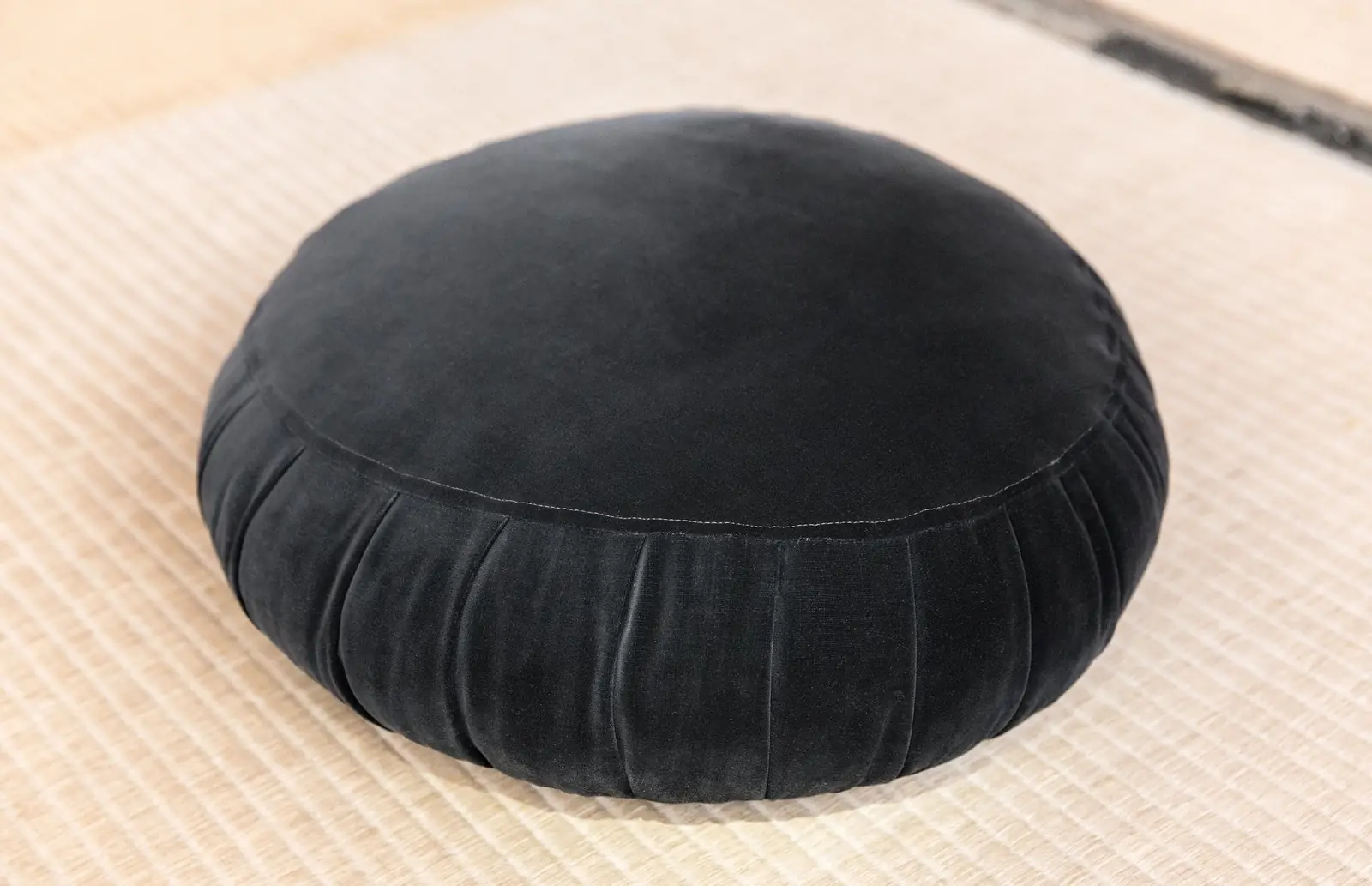
Students sit on cushions on the floor unless they need a chair. Dhamma Bāvarī says cushions are provided and you may bring your own. dhamma.org says chairs are provided for people who cannot sit comfortably on the floor because of age or a physical problem. Meditation benches are not mentioned on dhamma.org's main pages, so ask the centre if you want to use one, and mention injuries or physical limits on the application.
The sittings of strong determination from Day 4 involve trying not to change position for an hour. dhamma.org's guidance says not to attempt them if they might worsen a physical weakness or injury.
Other centres have their own arrangements: the Insight Meditation Society, for example, provides mats and cushions and invites retreatants to bring their own cushion or bench.
Practical preparation
- Plan for 12 days out of contact. The course spans 12 calendar days with no calls, messages or visitors. Give family the centre's details: in an emergency, they can contact the management.
- Expect early mornings. The bell rings at 4:00 am and lights go out at 9:30 pm. Suan Mokkh tells its students that body and mind take three or four days to adjust to a retreat. In the Day Seven discourse Goenka advises students who cannot sleep to rest lying down rather than worry about insomnia.
- Plan for no nicotine. Smoking, vaping and chewing tobacco are not allowed on the course.
- Check the language. Dhamma Shringa asks for conversational Nepali or English; Dhamma Pokhara and Dhamma Kitti list Hindi, English and Nepali.
To practise sitting still for a set time before the course, the meditation timer marks the start and end of a sitting with a bell.
Sources
- Introduction to the Technique and Code of Discipline, dhamma.org
- Questions & Answers About the Technique of Vipassana Meditation, dhamma.org
- Application form (generic English version, PDF), dhamma.org
- Course schedule: Dhamma Shringa, dhamma.org
- Support FAQ, dhamma.org
- Courses for teens, children.dhamma.org
- What to Bring, Dhamma Bāvarī
- Center Information: Dhamma Shringa, Nepal Vipassana Center
- The varieties of contemplative experience: A mixed-methods study of meditation-related challenges in Western Buddhists (Lindahl et al., PLoS One, 2017), PubMed
- What to Bring When You Come to an IMS Retreat (PDF), Insight Meditation Society
- FAQs About Retreats, Insight Meditation Society
- General information, Suan Mokkh International Dharma Hermitage
- Vipassana Centres in Nepal, np.dhamma.org
- The Discourse Summaries (S. N. Goenka, condensed by William Hart), Vipassana Research Institute