
The essentials · Part 4 of 10
The three trainings: sīla, samādhi and paññā
The four noble truths in brief, the Noble Eightfold Path grouped as ethics, concentration and wisdom, and how a 10-day course follows that order.
· 6 min read
On a 10-day Vipassana course, students first take precepts, then spend days calming the mind on the breath, and only then begin Vipassana itself. That order follows a structure found in the Buddha's discourses: the three trainings of ethics (sīla), concentration (samādhi) and wisdom (paññā). This guide explains the structure, starting from the teaching that frames it.
The four noble truths in brief
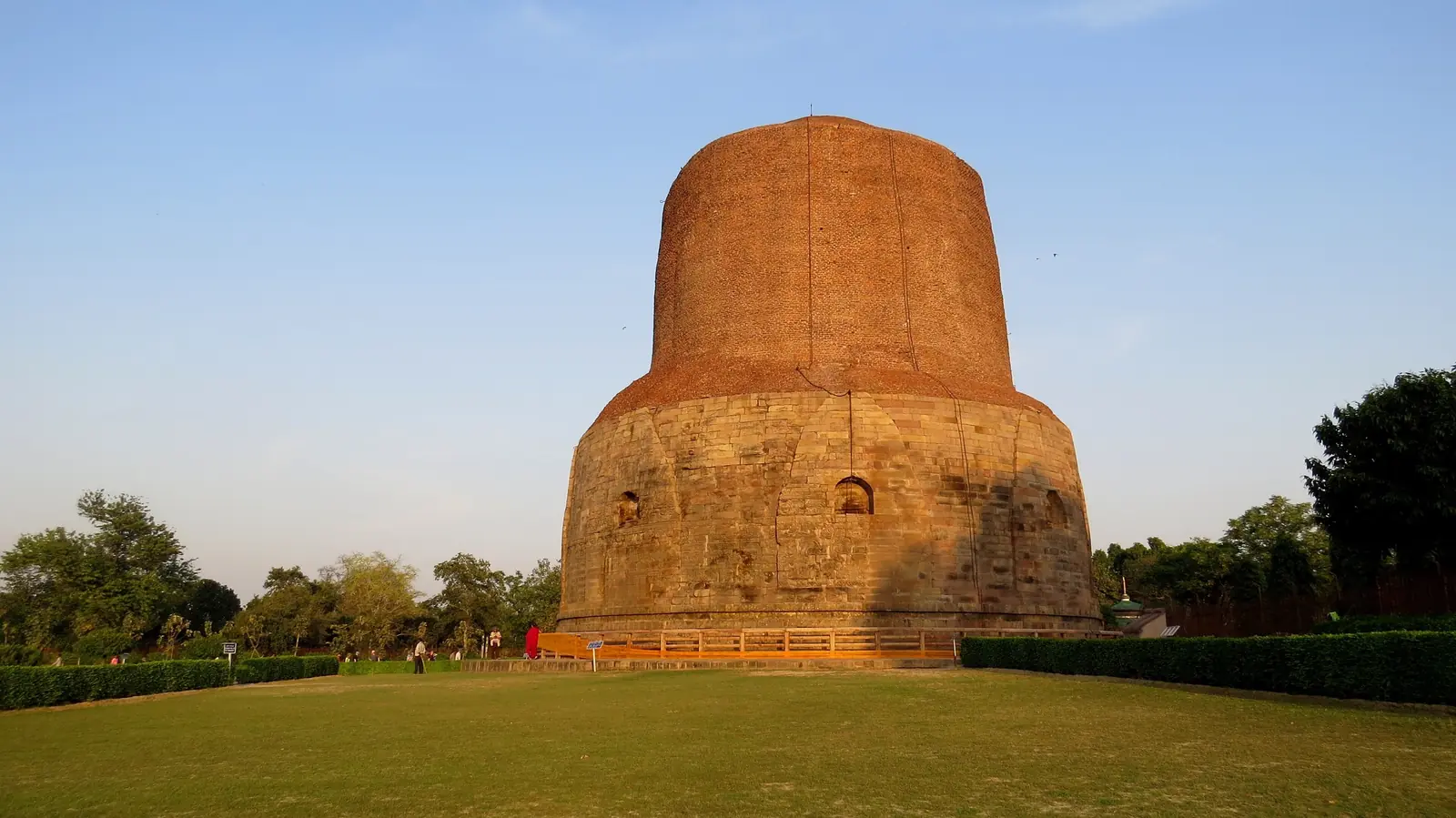
According to the Dhammacakkappavattana Sutta (SN 56.11), the Buddha's first teaching, in the deer park at Isipatana near Varanasi (today's Sarnath), set out four noble truths. In Bhikkhu Sujato's translation:
| Truth | What the discourse says | What is to be done with it |
|---|---|---|
| Suffering (dukkha) | Rebirth, old age, illness and death; being with what you dislike, parted from what you like, not getting what you wish for. "In brief, the five grasping aggregates are suffering." | Completely understood |
| Its origin | Craving (taṇhā): for sensual pleasures, for continued existence, and for non-existence | Given up |
| Its cessation | The fading away and cessation of that same craving, letting it go | Realised |
| The path | The Noble Eightfold Path | Developed |
The fourth truth is the practical one: it names the way of life and practice that leads out of suffering. Guide 6, impermanence, suffering and non-self, looks at the first truth more closely.
The Noble Eightfold Path
The same discourse calls the path the middle way between indulgence in sensual pleasure and self-mortification, and lists its eight factors. Sujato translates the last factor as "right immersion"; other translators say "right concentration".
- Right view (sammā-diṭṭhi)
- Right intention, or purpose (sammā-saṅkappa)
- Right speech (sammā-vācā)
- Right action (sammā-kammanta)
- Right livelihood (sammā-ājīva)
- Right effort (sammā-vāyāma)
- Right mindfulness (sammā-sati)
- Right concentration (sammā-samādhi)
Three groups: ethics, concentration and wisdom
In the Cūḷavedalla Sutta (MN 44), a layman named Visākha asks the nun Dhammadinnā how the eight factors relate to three larger groups. She answers that the three groups are not contained in the path; the path is contained in the three groups:
| Training | Nepali | Path factors |
|---|---|---|
| Ethics, sīla | शील | Right speech, right action, right livelihood |
| Concentration, samādhi | समाधि | Right effort, right mindfulness, right concentration |
| Wisdom, paññā | प्रज्ञा | Right view, right intention |
In the list of eight, wisdom comes first. In training, the order runs the other way, from ethics through concentration to wisdom. Another short discourse, AN 3.89, names these as the three trainings: in higher ethics, which for a monk means keeping the monastic code; in the higher mind, defined as the four meditative absorptions (jhāna); and in higher wisdom, defined as truly understanding the four noble truths. Buddhaghosa's 5th-century handbook, the Visuddhimagga, is arranged in the same three parts: virtue, concentration and understanding.
MN 44 adds a detail that matters for meditators. Asked what concentration is, Dhammadinnā says it is the unification of the mind, and that the four foundations of mindfulness (satipaṭṭhāna) are its basis. The next guide covers those four.
How the three support each other
In DN 16, the account of the Buddha's final travels, the same short talk is repeated at stop after stop, which the text says he "often gave" to the monks:
"Such is ethics, such is immersion, such is wisdom. When immersion is imbued with ethics it's very fruitful and beneficial. When wisdom is imbued with immersion it's very fruitful and beneficial. When the mind is imbued with wisdom it is rightly freed from the defilements, namely, the defilements of sensuality, desire to be reborn, and ignorance."
S. N. Goenka's evening talks on a 10-day course explain the same chain in practical terms. In the Day Two and Day Three talks, as VRI summarises them:
- Ethics alone is not enough. A person may understand intellectually that harmful actions should be avoided and still commit them, because they have no control over the mind. Hence the second training, concentration.
- Concentration alone is not enough. Concentration can suppress mental defilements but does not remove them; they remain in the unconscious. Goenka also says that right concentration must have a base of purity: a mind focused with craving or aversion is not practising right concentration.
- Wisdom completes the path. Goenka distinguishes wisdom received from others, wisdom from intellectual understanding, and wisdom from one's own experience, and says only the third liberates. His example is a sick man who recites a doctor's prescription, then has it explained, and is cured only when he takes the medicine.
How much concentration insight needs is one of the main differences between traditions. A Goenka course gives about three days to the breath before Vipassana. The Mahasi method, in Spirit Rock's account, works through continuous noting and "momentary concentration", without first attaining jhāna, while Pa-Auk Sayadaw teaches deep concentration and then directed insight. Guide 7, samatha and vipassana, sets out this debate.
Why a course begins with precepts
Every student on a course in Goenka's tradition keeps five precepts: to abstain from killing any being, from stealing, from all sexual activity, from telling lies, and from all intoxicants. During the course the third precept is stricter than in daily life, where it concerns sexual misconduct. Old students, who have completed a course in this tradition before, keep three more: no food after midday, no sensual entertainment or bodily decoration, and no high or luxurious beds.
dhamma.org's Code of Discipline calls moral conduct the foundation of the practice: it supports concentration, and the mind is purified through the wisdom of insight. In the Day Ten talk, as VRI summarises it, Goenka tells students that taking the precepts was not a rite or ritual. His reasoning is that a person cannot purify the mind while still committing actions that agitate it; on a course, the full timetable, the discipline, the silence and the supportive atmosphere make breaking the precepts unlikely, so for ten days students can keep them and build concentration and insight on that base. In the Day Nine talk he adds that speech is the one place a student is still likely to slip, which is one reason for Noble Silence.
How a 10-day course maps onto the three trainings
| When | Training | What happens |
|---|---|---|
| Day 0, evening | Ethics | Students take the precepts and Noble Silence begins |
| Days 1 to 3 | Concentration | Ānāpāna: attention to the natural breath as it enters and leaves the nostrils |
| Day 4 onwards | Wisdom | Vipassana: observing sensations throughout the body, understanding their nature and developing equanimity |
| Day 10 | A closing practice | Loving-kindness (mettā); speech resumes |
Ethics does not stop on Day 0: the precepts and the discipline hold for the whole course. The evening talks follow the same order, with the Noble Eightfold Path's ethics and concentration on Day Two and wisdom on Day Three.
The International Meditation Centres, another organisation teaching in U Ba Khin's line, describe their course in the same terms: the path divided into higher training in morality, concentration and wisdom, with concentration developed during the first five days and Vipassana practised for the rest. The 10-day course, day by day describes Goenka's course in full.
Guide 5, the four foundations of mindfulness, looks at the discourse behind right mindfulness and the practices it describes.
Sources
- Dhammacakkappavattana Sutta: Rolling Forth the Wheel of Dhamma (SN 56.11), SuttaCentral
- Cūḷavedalla Sutta: The Shorter Elaboration (MN 44), SuttaCentral
- Sikkhattaya Sutta: Three Trainings (AN 3.89), SuttaCentral
- Mahāparinibbāna Sutta: The Great Discourse on the Buddha's Extinguishment (DN 16), SuttaCentral
- The Path of Purification (Visuddhimagga), trans. Bhikkhu Ñāṇamoli, Buddhist Publication Society, via Access to Insight
- Introduction to the Technique and Code of Discipline, dhamma.org
- Vipassana Meditation, dhamma.org
- The Discourse Summaries (S. N. Goenka, condensed by William Hart), Vipassana Research Institute
- Meditation, International Meditation Centre UK
- Our Buddhist Lineage, Spirit Rock Meditation Center