
Loading…
Practice
Mindfulness of breathing from the Ānāpānasati Sutta (MN 118): how each tradition uses the breath, simple beginner guidance and common difficulties.
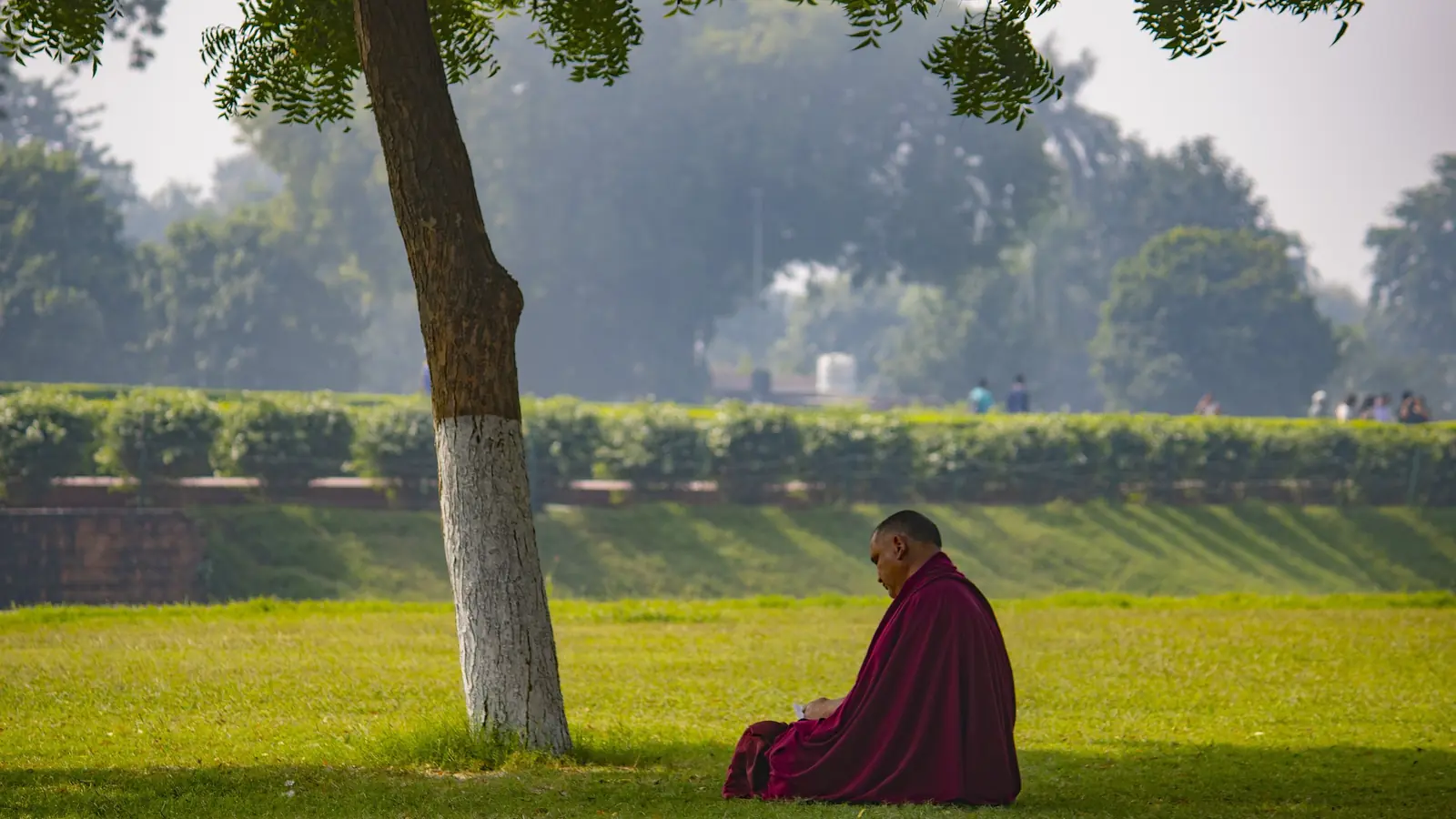
Ānāpāna (आनापान) is the Pali word for the in-breath and the out-breath. Ānāpānasati means mindfulness of breathing: keeping attention on breathing as it happens. It is the first practice taught on many Vipassana courses, and most of the traditions described on this site use the breath in some way, though they rest attention in different places and use it for different ends.
The main canonical text is the Ānāpānasati Sutta, discourse 118 of the Majjhima Nikāya. In Bhikkhu Sujato's translation, a meditator goes to a wilderness, the root of a tree or an empty hut, sits cross-legged, sets the body straight and brings mindfulness to the present: "Just mindful, they breathe in. Mindful, they breathe out."
The sutta makes a large claim for the practice. Developed and cultivated, it says, mindfulness of breathing fulfils the four kinds of mindfulness meditation (satipaṭṭhāna); these fulfil the seven awakening factors, and those fulfil knowledge and freedom. It then sets out 16 steps in four groups, one group for each satipaṭṭhāna. Each step is practised breathing in and breathing out.
| Group | The four steps, in brief |
|---|---|
| Body | 1–2 knowing a breath as heavy or light ("long or short" in other translations) · 3 experiencing the whole body · 4 stilling the physical process |
| Feelings | 5 experiencing rapture · 6 experiencing bliss · 7 experiencing the mental process · 8 stilling it |
| Mind | 9 experiencing the mind · 10 gladdening it · 11 immersing it in samādhi · 12 freeing it |
| Principles | 13 observing impermanence · 14 fading away · 15 cessation · 16 letting go |
The first four steps also appear in the breathing section of the Satipaṭṭhāna Sutta; see the four foundations of mindfulness. The last group names impermanence (anicca) and letting go. Suan Mokkh, the Thai hermitage founded by Buddhadāsa Bhikkhu, describes ānāpānasati as covering both concentration and insight meditation.
The same sutta is taught in quite different ways. Where attention rests, and what the breath is meant to lead to, depends on the tradition.
| Tradition | Where attention rests | What it leads to |
|---|---|---|
| Goenka | The natural breath at the nostrils, then sensations in that small area | About three and a half days of concentration, then vipassanā on body sensations |
| IMC | A spot at the base of the nose, for about the first five days | Concentration, then vipassanā |
| Mahasi | The rising and falling of the abdomen, noted silently | Continuous noting and insight |
| Pa-Auk | The place the breath touches, at the upper lip or nostrils | Usually jhāna, then insight |
| Thai Forest | The nose-tip (Ajahn Chah); "Buddho" with each breath (Ajahn Lee) | A calm, collected mind |
| Suan Mokkh | Breathing, as Buddhadāsa Bhikkhu taught ānāpānasati | Concentration in the first days, then insight |
| Sunlun | The touch of deliberately strong, fast breathing | Quick concentration, then the unpleasant sensation it produces |
| Mogok | The breath, briefly, when the mind is restless | Calm before contemplating feeling and mind |
On S. N. Goenka's courses students observe the breath "without adding any word, shape, or form". His Day Ten discourse gives two reasons: breath is common to everyone, while a word or form may be acceptable to some and not to others; and the course investigates reality as it is, which cannot start from an imagination. Ajahn Lee Dhammadharo, a Thai forest teacher, takes a different approach: in his Method 2 the meditator thinks bud- with the in-breath and dho with the out-breath.
Mahasi Sayadaw's centres watch the abdomen rather than the nostrils. His biography explains that the average meditator finds this movement, which it treats as the element of motion (vāyodhātu), easier to note. It adds that the method is not imposed: a meditator at a Mahasi centre may practise ānāpānasati instead.
In Pa-Auk Sayadaw's manual Knowing and Seeing, the meditator stays with the breath at the place it touches and does not follow it into or out of the body. As concentration develops, a sign of concentration (nimitta) may appear. The manual uses the breath to reach jhāna, deep meditative absorption, before the meditator turns to insight.
Breath awareness is one of the few practices that teachers across traditions describe in public for beginners. The points below summarise that published guidance. They are not a course: every tradition teaches the later stages with a teacher.
The meditation timer on this site rings a bell to begin and end a sit, with optional interval bells.
A short daily sit is very different from an intensive silent retreat. For what can happen on long retreats, and what the research says, read difficult experiences on meditation retreats.