
The essentials · Part 2 of 10
The Buddha and the origins of Vipassana
Who the Buddha was, the four places of his life from Lumbini in Nepal to Kushinagar, and what the early texts say he taught about meditation.
· 7 min read
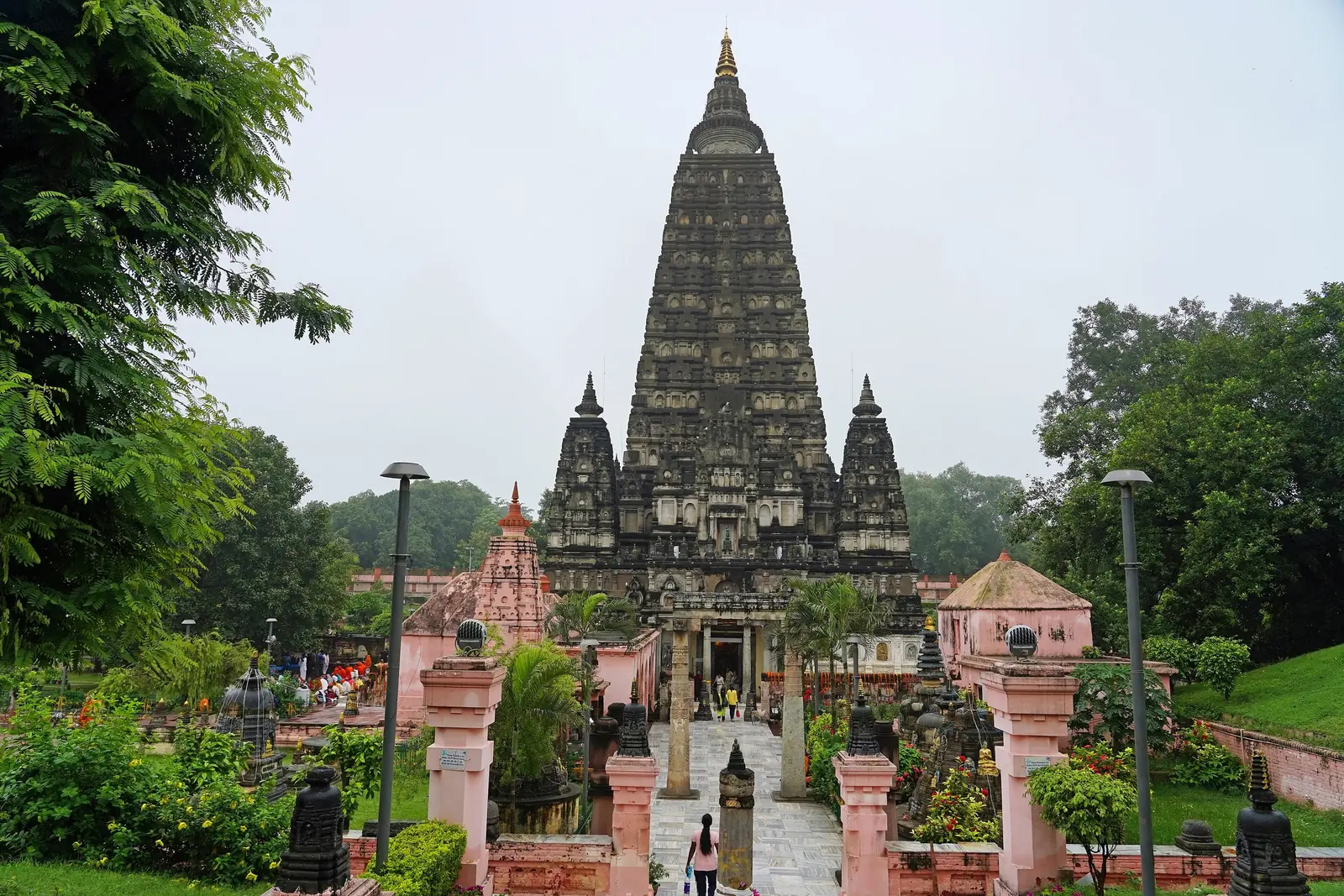
Every tradition described on this site traces its practice to one teacher, the Buddha, who was born in what is now southern Nepal and taught in northern India about two and a half thousand years ago. This guide follows his life through the four places the early texts single out, then looks at what those texts say he taught about meditation. For a shorter profile, see the Buddha.
Who the Buddha was, and when he lived
UNESCO's listing for Lumbini names him Siddhartha Gautama. The Pali discourses call him Gotama and record that his father was a Sakyan, a member of the Sakya clan. "Buddha" is a title: it means one who has awakened. In the discourses he often refers to himself as the Tathāgata, which Bhikkhu Sujato translates as "the Realized One".
His dates are debated. UNESCO's listing gives 623 BCE for his birth. The Stanford Encyclopedia of Philosophy notes that scholars until recently put his dates at about 560–480 BCE, and that many now hold he died around 405 BCE. The texts agree on one thing: near the end of his life he says he is eighty. A fair summary is that he lived in the 5th century BCE or somewhat earlier.
The four places named in the texts
Shortly before his death, in the Mahāparinibbāna Sutta (DN 16), the Buddha tells his attendant Ānanda of four places that a person of faith should go to see: where the Realised One was born, where he awakened, where he first taught, and where he passed away. They remain the main places of Buddhist pilgrimage.
| Event | The place in the early sources | The place today |
|---|---|---|
| Birth | Lumbini, recorded on Ashoka's pillar there | Lumbini, Rupandehi District, Nepal |
| Awakening | Uruvelā, by the Nerañjarā river | Bodh Gaya, Bihar, India |
| First teaching | The deer park at Isipatana, near Varanasi | Sarnath, Uttar Pradesh, India |
| Death | Kusinārā, in the land of the Mallas | Kushinagar, Uttar Pradesh, India |
Birth at Lumbini, in today's Nepal
Lumbini lies in the Terai plains of southern Nepal. UNESCO, which inscribed it as a World Heritage Site in 1997, says the birth there is testified by the inscription on a pillar erected by the Mauryan emperor Ashoka in 249 BCE, and that its remains contain evidence of Buddhist pilgrimage from as early as the 3rd century BCE.
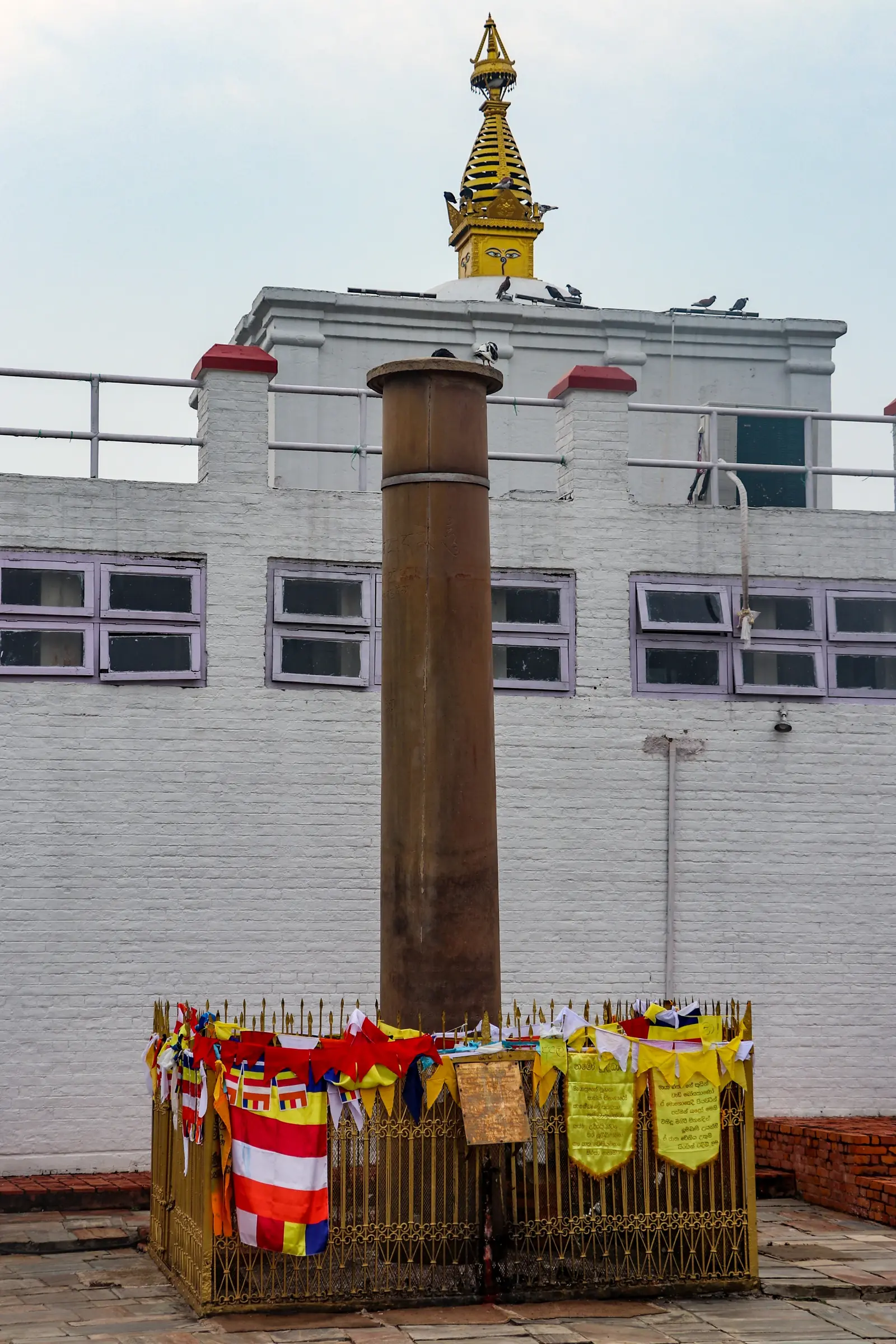
The site today, and the other Buddhist places in Nepal, are described in Lumbini and the Buddha's places in Nepal.
Leaving home and searching for a method
The fullest early account of the search is the Mahāsaccaka Sutta (MN 36), in which the Buddha tells it in his own words. While still young, "with pristine black hair" and against the tearful wishes of his parents, he shaved his head, put on ochre robes and left home. In DN 16 he says he was twenty-nine.
He studied under two meditation teachers, Āḷāra Kālāma and Uddaka, son of Rāma. With each he quickly reached the highest state they taught, a refined meditative attainment. With each he left, because it led only to rebirth in that state, not to awakening.
He then practised severe austerities: he tried to stop his breathing, and ate so little that his skin darkened and his body wasted. He concluded that this painful work had brought no superhuman knowledge and asked whether there could be another path.
The answer came from a memory. As a boy, sitting in the shade of a jambu tree while his father worked, he had entered the first meditative absorption (jhāna), a state of rapture and bliss born of seclusion. He understood that this was the path to awakening, and that a pleasure with nothing to do with the senses or with unskilful qualities was nothing to fear. He began to eat again. The five ascetics who had attended him took this as giving up, and left.
Awakening at Uruvelā
In MN 36 the Buddha settles at Uruvelā, near the town of Senā, in a grove beside a clear river. With his strength regained he enters the four absorptions. Then, with his mind "immersed in samādhi", purified, steady and workable, he turns it through the night towards three kinds of knowledge. The last is the understanding of suffering, its origin, its cessation and the way to its cessation, and with it his mind is freed.
The account joins two things that later traditions keep together: a concentrated mind (samādhi) and the understanding it makes possible (paññā). Guide 4, the three trainings, follows that thread.
The place is known today as Bodh Gaya, in the Indian state of Bihar. UNESCO, which inscribed the Mahabodhi Temple Complex there in 2002, calls it one of the four holy sites of the Buddha's life, associated above all with the Enlightenment. The first temple on the site was built by Ashoka in the 3rd century BCE; the present temple dates from the 5th or 6th century CE.
The first teaching at Sarnath
The Buddha went to the same five companions in the deer park at Isipatana, near Varanasi. What he told them is recorded in the Dhammacakkappavattana Sutta (SN 56.11), "Rolling Forth the Wheel of Dhamma". He described two extremes to avoid, indulgence in sensual pleasure and self-mortification, and a middle way between them: the Noble Eightfold Path of right view, purpose, speech, action, livelihood, effort, mindfulness and concentration. He then set out the four noble truths: suffering, its origin in craving, its cessation, and the path.
While he spoke, the text says, one of the five, Koṇḍañña, gained the "vision of the Dhamma", which it puts in a single line:
"Everything that is liable to arise is liable to cease."
Seeing this for oneself, directly, is close to what later guides call insight into impermanence. UNESCO, which added the Ancient Buddhist Site of Sarnath to the World Heritage List in July 2026, notes that in Buddhist tradition the site is also called Isipatana and Mrigadava, and describes it as one of the four key destinations of Buddhist pilgrimage.
Death at Kusinārā
In DN 16 the Buddha, aged eighty, goes with Ānanda to Kusinārā and lies down between a pair of sal trees in the sal forest of the Mallas nearby. His last words are vayadhammā saṅkhārā, appamādena sampādetha, in Sujato's translation "Conditions fall apart. Persist with diligence." The text then describes him passing up and down through the meditative absorptions and dying from the fourth absorption.
Kusinārā is today's Kushinagar, in Uttar Pradesh. The district's official site notes that the Pali texts name Kushinara as a capital of the Mallas, that the Chinese pilgrims Faxian and Xuanzang mention it, and that the Buddha was cremated at Ramabhar, where the Mallas built a stupa over the ashes.
What the early texts say about meditation
The Buddha taught for the rest of his life, and the Pali discourses record many teachings on meditation. Two of them set out the practice of mindfulness (sati) in the most detail, and Vipassana traditions draw on both. Both describe the same setting: a practitioner goes to a wilderness, the root of a tree or an empty hut, sits cross-legged, sets the body straight and brings mindfulness to the present.
The Satipaṭṭhāna Sutta (MN 10)
The Satipaṭṭhāna Sutta, given among the Kurus, sets out four ways of establishing mindfulness (satipaṭṭhāna): observing the body (kāya), feelings (vedanā), the mind (citta) and dhammā, which Sujato translates as "principles". It calls these the ekāyano maggo, rendered by Sujato as "the path to convergence", and says they purify beings, end sorrow, pain and sadness, and lead to nibbāna, extinguishment.
The same phrase repeats through every exercise: the practitioner is keen, aware and mindful, free of desire and aversion for the world. The sutta ends by saying that anyone who develops the four in this way for seven years, or even seven days, can expect awakening in this life or the stage just short of it. Guide 5, the four foundations of mindfulness, goes through them one by one.
The Ānāpānasati Sutta (MN 118)
The Ānāpānasati Sutta is about mindfulness of breathing (ānāpānasati). It sets out a chain: mindfulness of breathing, developed, fulfils the four foundations of mindfulness; these fulfil the seven factors of awakening; and these fulfil knowledge and freedom.
The practice is laid out as sixteen steps in four groups of four, one group for each foundation of mindfulness. The first group concerns the body, beginning with knowing each breath, long or short (Pali dīgha and rassa, which Sujato renders "heavily" and "lightly"). The last group, for dhammā, is observing impermanence, fading away, cessation and letting go. The first four steps also appear, word for word, in the breathing section of MN 10.
Breath meditation as the traditions teach it today is described on the Anapana page; the way each tradition builds on these two discourses is set out in the techniques section.
Guide 3, how Vipassana survived, follows the teaching from the Buddha's death to the meditation centres of today.
Sources
- Mahāparinibbāna Sutta: The Great Discourse on the Buddha's Extinguishment (DN 16), SuttaCentral
- Mahāsaccaka Sutta: The Longer Discourse With Saccaka (MN 36), SuttaCentral
- Dhammacakkappavattana Sutta: Rolling Forth the Wheel of Dhamma (SN 56.11), SuttaCentral
- Satipaṭṭhāna Sutta: Mindfulness Meditation (MN 10), SuttaCentral
- Ānāpānasati Sutta: Mindfulness of Breathing (MN 118), SuttaCentral
- Lumbini, the Birthplace of the Lord Buddha, UNESCO World Heritage Centre
- Mahabodhi Temple Complex at Bodh Gaya, UNESCO World Heritage Centre
- Ancient Buddhist Site of Sarnath inscribed on UNESCO World Heritage List, UNESCO
- Culture & Heritage, District Kushinagar, Government of Uttar Pradesh
- Buddha (Mark Siderits), Stanford Encyclopedia of Philosophy