Lumbini and the Buddha's places in Nepal
Lumbini, Tilaurakot (Kapilavastu), Ramagrama and Devadaha: what stands at each site, what is known about it, and the meditation centres nearby.
Vipassana Nepal team · · 7 min read
Four places tied to the Buddha's life lie in the western Terai of Nepal, all within about 60 km of Lumbini: Lumbini itself, where he was born; the Sakya capital of Kapilavastu, where he grew up, which many scholars identify with Tilaurakot; Devadaha, his mother's home; and Ramagrama, where one of the stupas over his relics stands. This page describes each site as the official bodies and the archaeology describe it, and lists the meditation centres nearby.
Lumbini, the birthplace
The early texts place the birth here. A verse in the Sutta Nipāta says the future Buddha was born "in Lumbinī, a village in the Sakyan land" (Snp 3.11). In the Mahāparinibbāna Sutta the Buddha names the place where he was born as the first of four places a devoted follower should go to see (DN 16).
UNESCO inscribed "Lumbini, the Birthplace of the Lord Buddha" on the World Heritage List in 1997. The property and its buffer zone belong to the Government of Nepal and are managed by the Lumbini Development Trust (LDT). UNESCO and the LDT give 623 BCE as the year of the birth. Scholars have not agreed on the Buddha's dates, and he is generally placed in the fifth century BCE or somewhat earlier; the Buddha and the origins of Vipassana sets the dates side by side.
The Maya Devi Temple and the marker stone
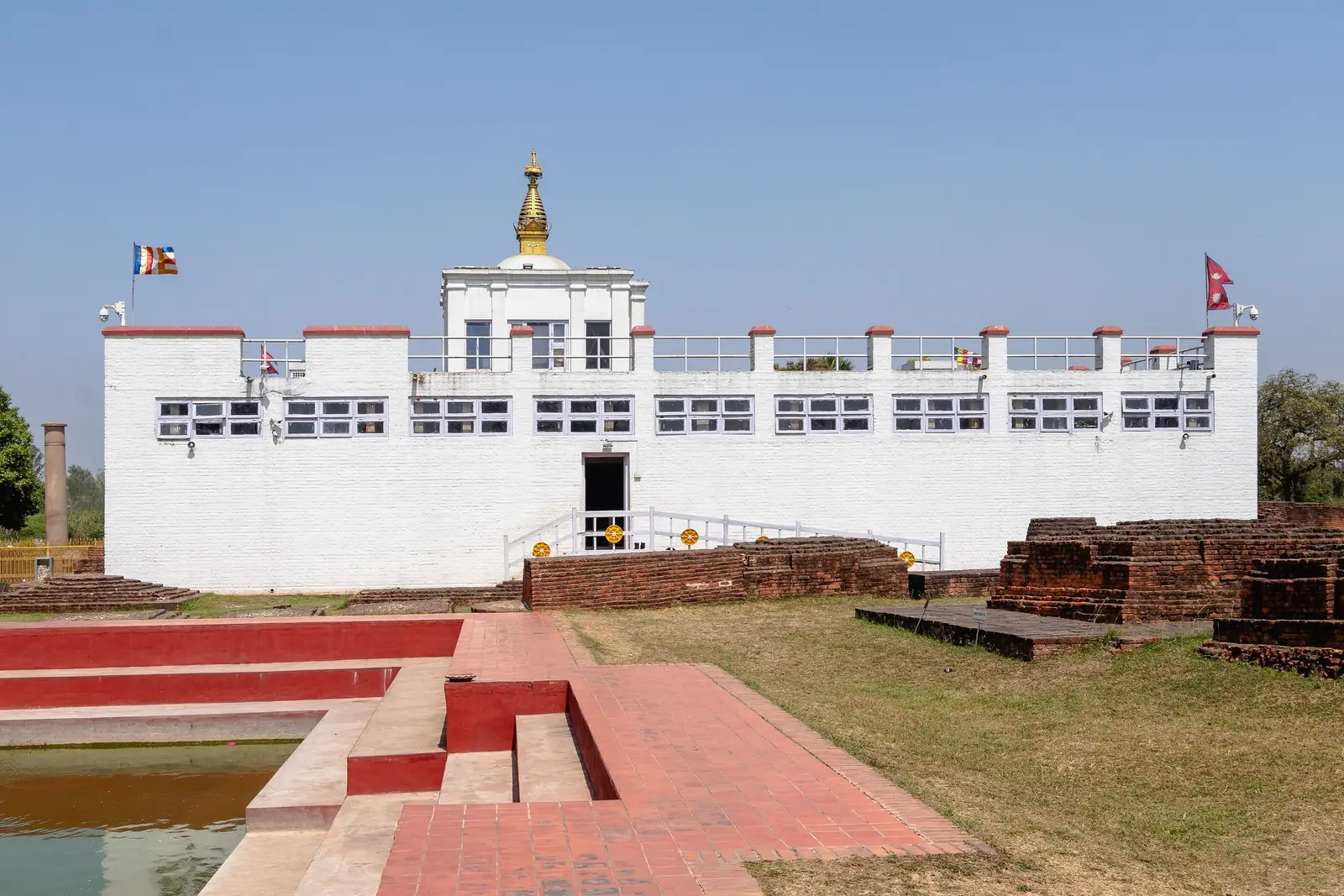
The Maya Devi Temple marks the birthplace. Inside are the marker stone, which the LDT says designates the exact spot, found during excavations of the temple in the 1990s; a birth scene carved in red sandstone, found in 1899; and the remains of earlier buildings. The present temple was rebuilt by the LDT in 2003.
Excavations sponsored by UNESCO and published in the journal Antiquity in 2013 found a sequence of early structures at the site, older than Emperor Ashoka's major rebuilding in the third century BCE. The authors describe durable brick architecture replacing earlier timber, and present the site as direct evidence of what an early Buddhist shrine looked like.
The Ashoka pillar and its inscription
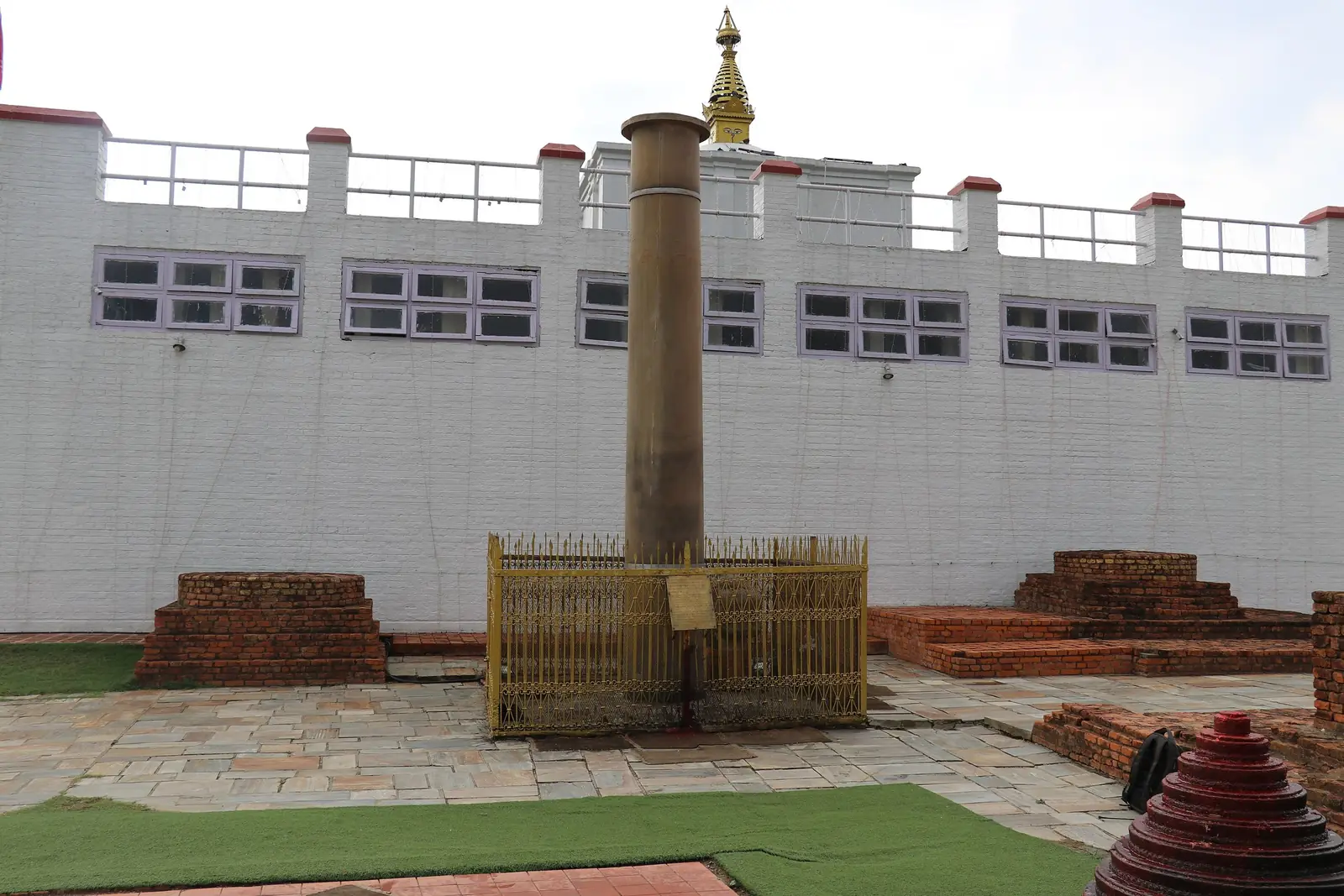
Beside the temple stands the stone pillar that the Mauryan emperor Ashoka set up in 249 BCE, the date UNESCO and the LDT give. The LDT calls its inscription, in Brahmi script, the most reliable evidence that the Buddha was born here. In the LDT's translation, it records that King Piyadasi (Ashoka) came here in person in the twentieth year of his reign; that because Sakyamuni Buddha was born here, the spot was worshipped and a stone pillar set up; and that the village's tax was reduced to one-eighth.
The Chinese pilgrims Faxian and Xuanzang both described the pillar. It was rediscovered in 1896 by General Khadga Shumsher Rana, then governor of Palpa, and the archaeologist Alois Führer. The LDT gives its present height as 9.41 m, with almost half of it below ground; its lotus-shaped bracket is displayed nearby, and the figure that once crowned it has never been found.
The sacred garden and the pond
The temple and pillar stand in the Sacred Garden, together with the sacred pond, called the Puskarini, and the excavated remains of monasteries and stupas. Tradition holds that Maya Devi bathed in the pond before giving birth. The LDT says it lies 25 paces south-west of the marker stone and was given its brick embankment during excavations in 1933–39.
The LDT counts 31 stupas excavated in the garden so far, built between the third century BCE and the eighth or ninth century CE, and two groups of monastery remains south and south-east of the temple.
The Master Plan and the Monastic Zone
Modern Lumbini follows a master plan by the Japanese architect Kenzo Tange, commissioned after the UN Secretary-General U Thant visited in 1967 and approved by the Nepalese government in 1978. It covers an area of one by three miles in three zones: the Sacred Garden, the Monastic Zone and a cultural centre with New Lumbini Village. The Lumbini Development Trust has overseen the work since it was set up in 1985.
The Monastic Zone is divided by a 1.6 km walkway and canal. The East Monastic Zone has 13 plots for Theravāda monasteries, and the LDT lists Dhamma Jananī, a Vipassana centre in S. N. Goenka's tradition, among the institutions there. The West Monastic Zone has 29 plots for Mahāyāna monasteries, and the LDT's list includes Panditarama Lumbini, which teaches in the Mahasi tradition. The LDT's lists for the two zones include monasteries from Thailand, Myanmar, Sri Lanka, Cambodia, China, South Korea and Vietnam.
Tilaurakot and ancient Kapilavastu
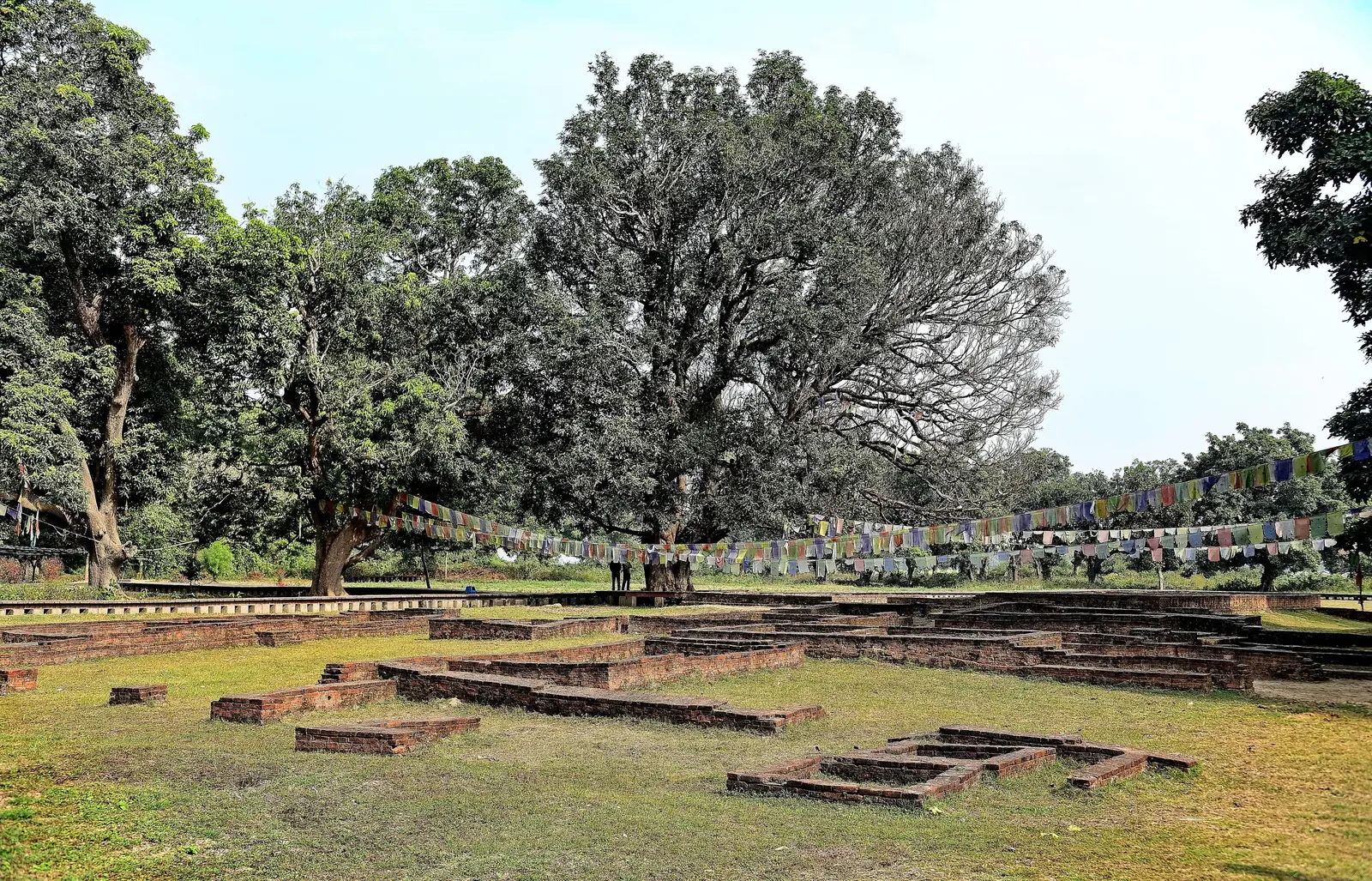
Tilaurakot lies about 29 km west of Lumbini and 3 km north-west of Taulihawa, in Kapilvastu district. Rediscovered in 1899, it is identified by many scholars, the LDT says, as the capital of the Sakya kingdom where Prince Siddhartha spent his early life. The site is a raised area inside a wide, tall fortification wall and a moat. Excavations have found remains from the ninth or eighth century BCE to the second or third century CE, among them palace buildings, temples, ponds, roads and a site for minting coins.
Nepal put Tilaurakot on UNESCO's Tentative List in 1996 as "Tilaurakot, the archaeological remains of ancient Shakya Kingdom". A Tentative List is UNESCO's inventory of sites a country intends to consider for nomination; Tilaurakot is not a World Heritage Site.
The LDT counts more than 130 archaeological sites in the ancient Kapilavastu area. They include Kudan, which the LDT identifies with the ancient Nigrodharama, where the Buddha met his father for the first time after his awakening, and Gotihawa and Niglihawa, where Ashoka set up pillars at places associated with two earlier Buddhas.
Dhamma Nandana, a Goenka-tradition centre, is in the Kapilvastu Mahavana forest on the right bank of the Banganga River, about 40 km north-west of Lumbini. The centre identifies the forest as the place where the Buddha taught the Mahāsamaya Sutta.
Ramagrama, the relic stupa
Ramagrama lies about 50 km east of Lumbini and 29 km east of Bhairahawa, in Nawalparasi district. Nepal put it on the Tentative List in 1996 as "Ramagrama, the relic stupa of Lord Buddha", describing it as the only undisturbed original stupa containing relics of the Buddha.
The tradition the LDT recounts is that after the Buddha's cremation his relics were divided among eight claimants, one of them the Koliyas of Ramagrama, who built a stupa over their share. In this account Ashoka came in 249 BCE meaning to open the stupa and share out its relics, but left it untouched. What visitors see is a brick mound about 7 m high, found in 1899 and confirmed as a stupa by Nepal's Department of Archaeology in excavations in 1997. The LDT says the core of the stupa has been left untouched out of respect for it.
A Goenka-tradition centre, Dhamma Gāma, is planned in the Ramgram area. The land has been acquired, but it had no permanent buildings when this was written.
Devadaha, the Koliya capital
Devadaha, about 57 km east of Lumbini, is identified by the LDT as the capital of the ancient Koliya kingdom and the home town of Maya Devi, the Buddha's mother, of his stepmother Prajapati Gotami and of his wife Yasodhara. It is not on UNESCO's lists. The LDT itself says a thorough archaeological investigation is still needed to pinpoint the ancient capital. Places it lists include Bhawanipur, with a temple to Maya Devi, and Khayardada, where excavations have found large bricks, pottery and structural remains.
Combining a visit with a course
A course and a visit to the sites have to come one after the other. dhamma.org's Code of Discipline asks students to stay within the course boundaries for the whole course, so plan to see the sites before or after it.
- Dhamma Jananī, in the East Monastic Zone, runs one 10-day course a month and two Satipatthana courses a year. Its hall seats nearly 200, and some courses are given in English and Chinese. Apply through its dhamma.org schedule.
- Panditarama Lumbini is open from the beginning of September to the end of March, for individual retreats of at least seven days. It runs on dāna, and asks meditators to contact it to arrange their dates.
- Dhamma Nandana, near Kapilavastu, has a hall for about 50 and holds 10-day and one-day courses.
The LDT says flights from Kathmandu to Bhairahawa take about 35 minutes, followed by an 18 km drive to Lumbini; the bus from Kathmandu takes 10–11 hours for about 280 km. At the Maya Devi Temple visitors remove their shoes, dress modestly and need a ticket. The LDT's fee list in 2026 included daily conservation fees and a 12-day "meditation pass" (Rs 500 for SAARC nationals, Rs 1,000 for others); ask your centre if it applies to you. How to apply for a course is covered in How to join a Vipassana course in Nepal.
Sources
- Sutta Nipāta 3.11 (Nālaka Sutta), SuttaCentral
- Mahāparinibbāna Sutta (DN 16), SuttaCentral
- Lumbini, the Birthplace of the Lord Buddha, UNESCO World Heritage Centre
- Tilaurakot, the archaeological remains of ancient Shakya Kingdom (Tentative List), UNESCO World Heritage Centre
- Ramagrama, the relic stupa of Lord Buddha (Tentative List), UNESCO World Heritage Centre
- Lumbini, Lumbini Development Trust
- Kapilavastu, Lumbini Development Trust
- Ramagrama Area, Lumbini Development Trust
- Devadaha Area, Lumbini Development Trust
- The earliest Buddhist shrine: excavating the birthplace of the Buddha, Lumbini (Nepal) (Coningham et al., Antiquity, 2013), Antiquity
- Introduction to the Technique and Code of Discipline, dhamma.org
- Location directory (Nepal), dhamma.org
- Panditarama Lumbini International Vipassana Meditation Center, Panditarama Lumbini