
Loading…
Tradition
Buddhadāsa Bhikkhu's mindfulness with breathing, taught on a silent 10-day retreat in English that starts on the 1st of every month at Suan Mokkh.
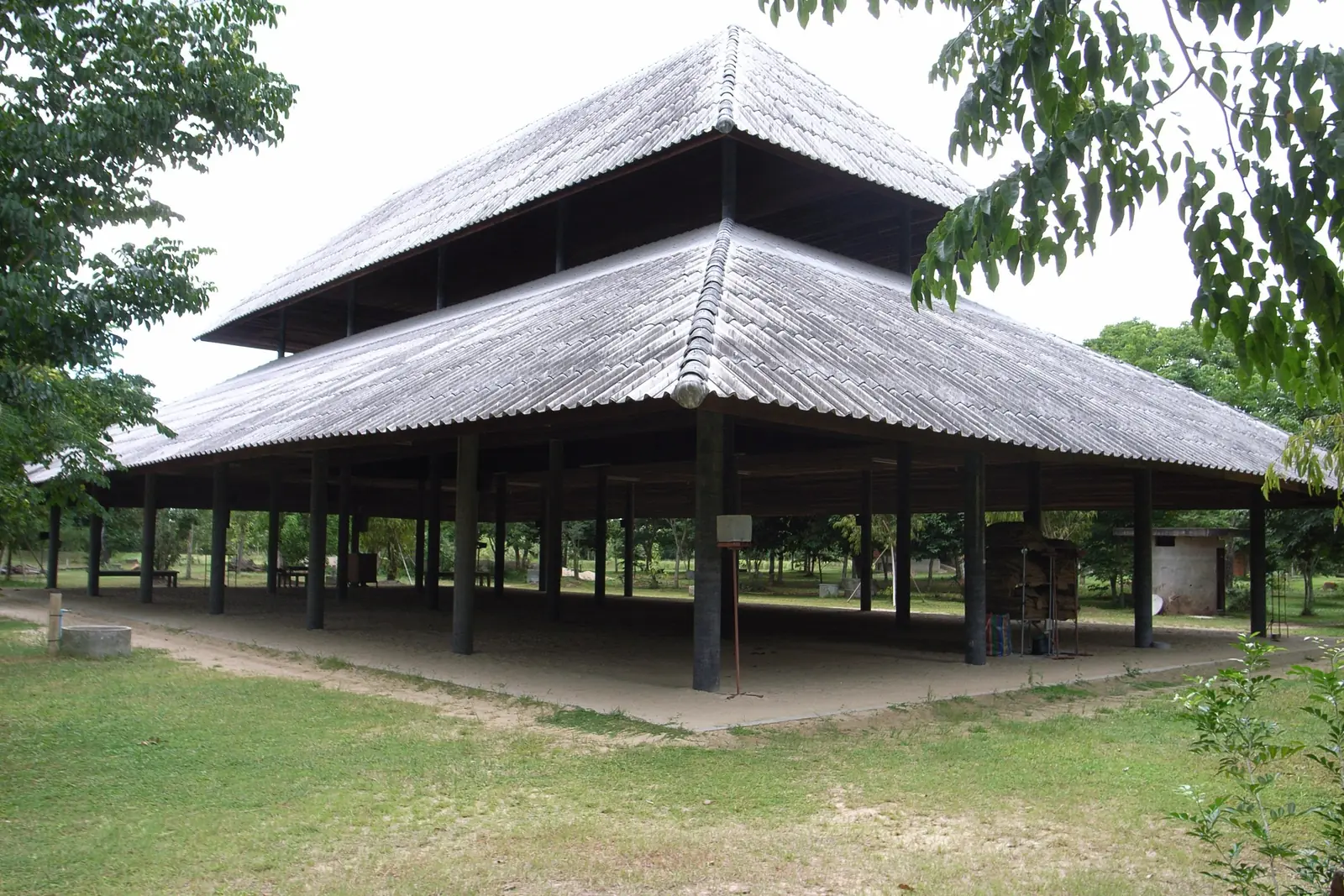
Suan Mokkh is the forest monastery that the Thai monk Buddhadāsa Bhikkhu founded in southern Thailand. The name is also used for the 10-day silent retreats in English held every month at its International Dharma Hermitage, near Chaiya in Surat Thani province. The retreats teach ānāpānasati, mindfulness with breathing, from Buddhadāsa's own recorded talks. They run on fixed dates, with walk-in registration, a single fee and simple living conditions.
Buddhadāsa Bhikkhu became a monk in 1926, at the age of 20. He founded Suan Mokkh in 1932 and, about ten years later, moved it to its present site near Chaiya. His last project was the International Dharma Hermitage, founded in 1986 as a place where people from all over the world could study and meditate. He died at Suan Mokkh in 1993.
Much of his teaching reached English readers through Santikaro, a former monk and his main translator, who also founded the audio archive at suanmokkh.org; the hermitage says it holds about 730 hours of recordings. The monastery itself is Wat Suan Mokkh, and the hermitage lies a short distance away.
Buddhadāsa's teaching departs from Theravāda orthodoxy on one well-documented point: dependent origination (paṭicca-samuppāda). The orthodox Theravāda reading spreads its twelve links across three lives: past, present and future. In a 2024 encyclopaedia entry, the scholar Dhivan Thomas Jones describes Buddhadāsa as an outspoken critic of that reading, who preferred to see the twelve links as events in the present moment. His main objection, in Jones's account, was that dependent origination taught across three lives cannot be practised.
Other Theravāda teachers keep the three-life reading; the Mogok method in Myanmar, for example, teaches it with a chart. The difference is one of interpretation, not a ranking of the two.
The hermitage describes its method as mindfulness with breathing, covering both concentration and insight. In the first days of a retreat, it says, the training is mainly in concentration (samādhi), by focusing attention on the breath; the retreat then moves on to insight (vipassanā). The meditation instruction consists of excerpts from Buddhadāsa's recorded talks on ānāpānasati.
The canonical source for the practice is the Ānāpānassati Sutta (MN 118). It gives sixteen steps in four groups of four, moving from the breath and the body through feeling and mind to contemplating impermanence, fading away, cessation and letting go. The hermitage does not say how many of the steps each retreat covers. Buddhadāsa's own manual, Mindfulness with Breathing: A Manual for Serious Beginners, is available in English in Santikaro's translation.
The daily programme adds Dhamma talks, walking or standing meditation, yoga or exercise ("mindfulness in motion") and, each afternoon, chanting and loving-kindness meditation. See Anapana, walking meditation and Mettā.
These are the hermitage's rules as published in September 2026:
By September 2023 the retreats had trained about 30,000 international visitors, aged from 17 to over 70, according to the hermitage.
| Time | Activity |
|---|---|
| 04:00 | Wake up |
| 04:30 | Morning reading, then sitting at 04:45 |
| 05:15 | Yoga or exercise |
| 07:00 | Dhamma talk and sitting |
| 08:00 | Breakfast and chores |
| 10:00 | Dhamma talk |
| 11:00 | Walking or standing meditation, then sitting |
| 12:30 | Lunch and chores |
| 14:30 | Meditation instruction and sitting |
| 15:30 | Walking or standing, then sitting |
| 17:00 | Chanting and loving-kindness meditation |
| 18:00 | Tea and hot springs |
| 19:30 | Sitting, group walking meditation, sitting |
| 21:00 | Bedtime (lights out 21:30) |
Every scheduled activity except yoga and exercise is compulsory. Retreatants keep complete silence, except for personal interviews between Day 3 and Day 6 and in emergencies, stay within the hermitage boundaries, keep the eight precepts and hand in phones and other devices. The hermitage warns that body and mind are not used to such different circumstances, and that adjusting, including to less sleep, takes three or four days.
There is a registration fee of 2,000 baht (as of 2026). It is not refundable, covers all expenses for the ten days, and there are no additional costs. This differs from the donation-only model of S. N. Goenka's courses and from the fee-plus-dāna model of Western insight centres.
Conditions are deliberately plain. Each retreatant has a small room with a hard bed, a simple straw mat and a wooden pillow. Toilets are shared, bathing is in Asian-style mandi bathrooms, and there are two vegetarian meals a day plus a drink in the evening. Clothing should cover the body from the shoulders to below the knees, including the upper arms; white is not required.
The retreats are held only at the Suan Mokkh International Dharma Hermitage. Wat Pah Nanachat, the Thai Forest monastery for Westerners, suggests Suan Mokkh or Dipabhavan, a related centre on Koh Samui, as places to gain retreat experience before a monastery stay. Other centres in the country are listed under Thailand.
1906–1993 · Thailand
Reforming Thai monk who founded Suan Mokkh and taught mindfulness with breathing (ānāpānasati)
2 centres in 1 countries. Always check dates and rules on the centre’s own site.
Chaiya, Surat Thani, Thailand · International Dharma Hermitage
Chaiya, Surat Thani, Thailand · Suan Mokkh Balarama