
The essentials · Part 10 of 10
Keeping up the practice at home
What S. N. Goenka's tradition asks of students after a 10-day course, the courses and service open to them, and what other traditions suggest.
· 5 min read
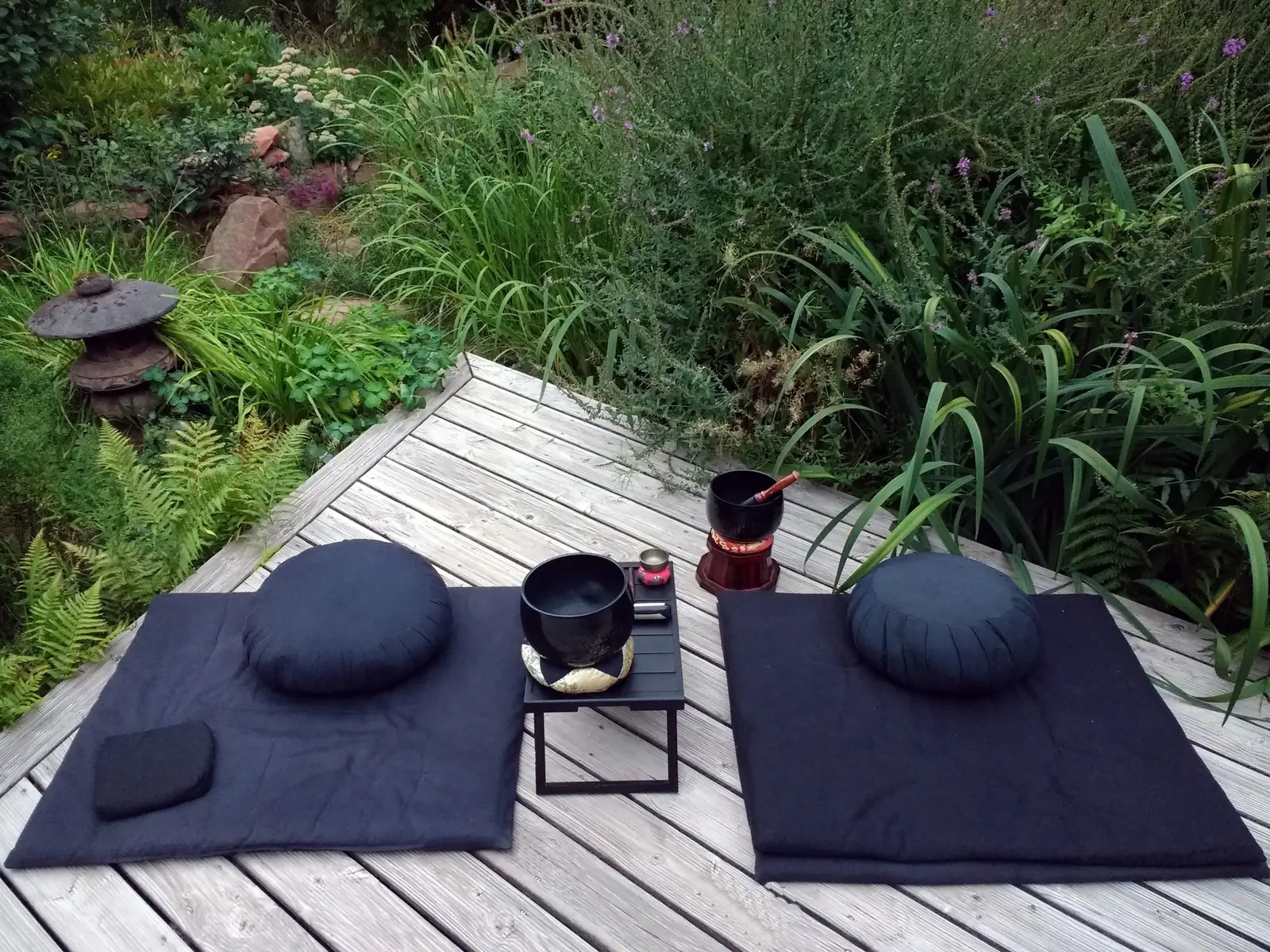
Goenka's closing discourse on a 10-day course is about how to continue practising once it ends. This guide sets out what S. N. Goenka's tradition asks of students afterwards, the courses and service open to them, and what some other traditions suggest for practice between retreats. It describes; the technique itself is learned on a course.
What Goenka's tradition recommends
Dhamma Bāvarī, a centre in India, publishes guidelines for practice after a course, including Goenka's message to old students. They set out a minimum:
"The minimum needed to maintain the practice: one hour in the morning and one hour in the evening, five minutes while lying in bed before you fall asleep and after you wake up, if possible, sitting once a week for one hour with other meditators practicing this technique of Vipassana, a ten-day course or self-course once a year, and other free time for meditation."
Goenka says the same in the closing discourse of the course, as summarised by the Vipassana Research Institute (VRI): daily meditation of two hours and a yearly ten-day retreat are only the minimum needed to maintain the practice. He advises using most of each daily sitting for Vipassana, and turning to Anapana only when the mind is agitated or dull.
The guidelines also cover daily life. Students are asked to keep the five precepts, with the third becoming abstention from sexual misconduct rather than from all sexual activity. Between sittings they suggest a brief return to awareness when a problem arises: "Whenever a problem arises, if possible be aware of your breath or sensations, even for a few seconds."
What one study found six months on
One controlled study, by Szekeres and Wertheim (2015), followed people through a standardised, community-based residential Vipassana course. After the course, participants reported lower stress and higher well-being, self-kindness and mindfulness than before. At a six-month follow-up of 90 participants, some gains had faded, especially in stress, but scores were still better than before the course. What research says about Vipassana covers the wider evidence.
Group sittings
In his closing discourse Goenka advises that where other Vipassana meditators live nearby, they meet once a week to meditate together for an hour. Group-sitting details sit in the old-students' sections of dhamma.org and np.dhamma.org, which need a login. dhamma.org gives old students access once they supply the teacher, date and country of their last course. The times of group sittings in Nepal are not public for that reason.
One-day and three-day courses
dhamma.org describes short courses of one to three days for anyone who has completed a 10-day course with Goenka or his assistant teachers, including people whose last course was some time ago. At Dhamma Shringa in Kathmandu they are booked through the City Office at Jyoti Bhawan, Kantipath, by phone. As of September 2026 its schedule listed four one-day courses and a three-day course before the end of the year.
Old students can also sit a self-course without a teacher. dhamma.org says anyone who has completed a 10-day course can decide to do one, usually at home or at another meditator's home, for one, two or three days or a full ten. It advises not to sit longer than ten days on your own.
Serving on a course
Old students can volunteer on courses. dhamma.org says anyone who has completed at least one 10-day course as taught by Goenka, and has not practised another meditation technique since their last course, may serve. The application form offers old students a choice to attend or serve. Service is unpaid and given as dāna; the Dhamma Bāvarī guidelines note that teachers and assistant teachers give their time the same way.
Longer courses
Longer courses in this tradition have entry requirements, set out in dhamma.org's course glossary. Local centres may add their own, and long courses use a separate application form.
| Course | Who can apply (summary) |
|---|---|
| Satipaṭṭhāna Sutta course (10 days) | At least three 10-day courses, a year of practice, no other techniques since the last course |
| Special 10-day and 20-day | Five 10-day courses, one Satipaṭṭhāna course, service on a 10-day course, two years of regular practice |
| 30-day | Six 10-day courses, one 20-day, one Satipaṭṭhāna course, two years of regular practice |
| 45-day | People in Dhamma service and assistant teachers, with seven 10-day courses, two 30-day courses and three years of practice |
| 60-day | Mainly active assistant teachers who have sat at least two 45-day courses |
The Satipaṭṭhāna Sutta course keeps the 10-day timetable, but its evening discourses examine the Satipaṭṭhāna Sutta. The guide to the four foundations of mindfulness describes that text.
What other traditions suggest
- Spirit Rock Meditation Center, California, publishes an introduction to insight meditation by Jack Kornfield and Gil Fronsdal. It describes a sitting of 20 or 30 minutes on a cushion or chair, suggests doing this simple practice every day, and asks meditators to carry the same awareness into the day's activities. See insight meditation in the West.
- Insight Meditation Society, Massachusetts, runs retreats from a weekend to three months. For long personal retreats at its Forest Refuge, applicants are expected to have sat six one-week retreats or one six-week course, or to have a long-term commitment to insight meditation.
- Thai forest monasteries in the lineage of Ajahn Chah open their routine to lay people. Abhayagiri in California holds a weekly Observance Day, when lay people join the evening gathering to take the precepts, meditate and hear a Dhamma talk. Wat Pah Nanachat in Thailand takes guests who already have meditation experience, preferably a retreat, for stays of at least a week and normally no more than 30 days, following the monastery's routine. See the Thai forest tradition.
A timer for daily sittings
This site's meditation timer is built for sittings like these. You choose a length (5 to 60 minutes, or your own number), an optional interval bell every 5, 10 or 15 minutes, and a few quiet seconds to settle before the opening bell. A bell marks the start and the end of the sitting. Your settings are stored only on your device. The timer keeps time; it gives no instructions.
Sources
- Guidelines for Practice, Dhamma Bāvarī
- The Discourse Summaries (S. N. Goenka, condensed by William Hart), Vipassana Research Institute
- Course Glossary, dhamma.org
- Support FAQ, dhamma.org
- Self-Course FAQs, dhamma.org
- Course schedule: Dhamma Shringa, dhamma.org
- Evaluation of Vipassana Meditation Course Effects on Subjective Stress, Well-being, Self-kindness and Mindfulness in a Community Sample (Szekeres and Wertheim, Stress and Health, 2015), PubMed
- Introduction to Insight Meditation, Spirit Rock Meditation Center
- Retreat Center, Insight Meditation Society
- FAQs About Retreats, Insight Meditation Society
- A Typical Day, Abhayagiri Monastery
- Visiting, Wat Pah Nanachat