
The essentials · Part 1 of 10
What is Vipassana?
What the word Vipassana means, what meditators actually do, how it relates to calm and to mindfulness, whether it is religious, and how it is learned.
· 7 min read
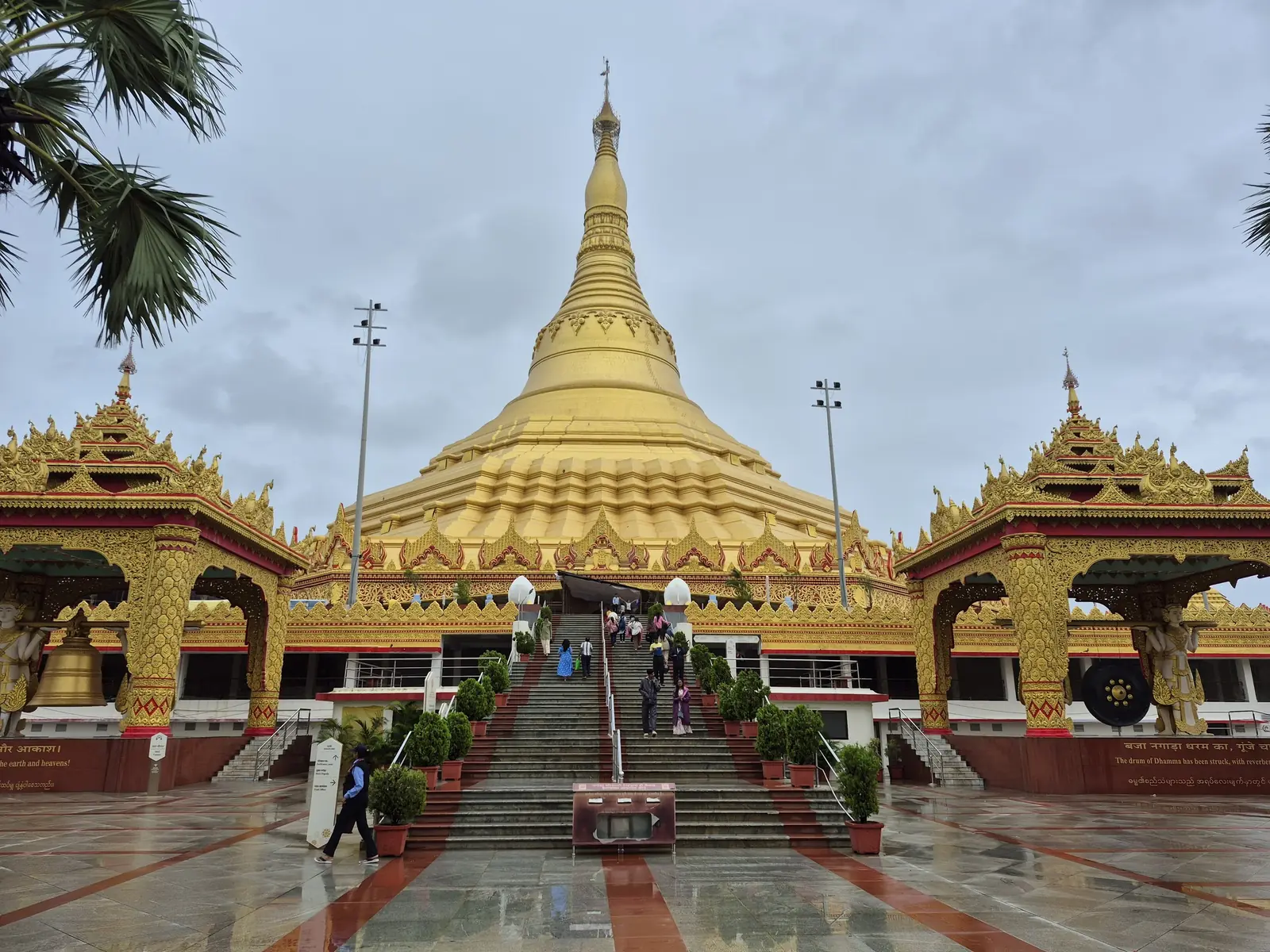
Vipassana is a kind of meditation that comes from the teaching of the Buddha. Several living traditions teach it, most of them rooted in Myanmar and Thailand, mainly on silent residential courses. This first of ten guides explains the word, what meditators actually do, how Vipassana relates to calm meditation and to modern mindfulness, how its teachers answer the question of religion, and where it is taught.
What the word vipassanā means
Vipassanā is a Pali word. Pali is the language of the canon of Theravāda Buddhism, the Buddhism of Sri Lanka, Myanmar, Thailand and neighbouring countries. The Pali Text Society's dictionary derives the word from the prefix vi- and passati, "to see", and translates it as inward vision, insight, intuition or introspection.
The Buddhist Sanskrit form is vipaśyanā. Nepali and Hindi follow the Sanskrit spelling and write विपश्यना; Pali texts printed in Devanagari write विपस्सना. In English the word is usually written without the long mark, as Vipassana.
Translators render it in different ways:
| Rendering | Used by |
|---|---|
| "insight" | Access to Insight's glossary |
| "inward vision, insight, intuition, introspection" | The Pali Text Society's dictionary |
| "to see things as they really are" | dhamma.org, in S. N. Goenka's tradition |
| "discernment" | Bhikkhu Sujato's translations on SuttaCentral |
Access to Insight gives the fuller sense: a clear, intuitive insight into physical and mental events as they arise and pass away, seeing them for what they are in terms of three characteristics. These are anicca (impermanence), dukkha (suffering, or unsatisfactoriness) and anattā (not-self). Guide 6, impermanence, suffering and non-self, explains all three.
What a Vipassana meditator actually does
In broad terms, a meditator sits, and in some traditions also walks, paying close and continuous attention to what is happening in their own body and mind: the breath, sensations, feelings, thoughts. The aim is to observe without reacting. dhamma.org describes the practice as observing sensations throughout the body and developing equanimity (upekkhā) by learning not to react to them. Spirit Rock, a Western centre, describes the Burmese methods as experiencing impermanence directly through continuous observation of changing experience.
How that attention is trained differs from one tradition to the next:
| Tradition | How it works, as the tradition describes it |
|---|---|
| S. N. Goenka, in the line of U Ba Khin | Attention to the natural breath (ānāpāna) for the first days of a course; from the fourth day, observing sensations throughout the body with equanimity; loving-kindness (mettā) on the last full day |
| Mahasi Sayadaw | Continuous mental noting of changing experience, used as a support for "momentary concentration" |
| Thai forest, from Ajahn Mun and Ajahn Chah | Calm and investigation developed together, inside a monastic way of life; Ajahn Chah treated ordinary activities as the place of practice |
| Western Insight Meditation | Mainly the Mahasi method, with repeated phrases to develop loving-kindness, and other lineages brought in on purpose |
Sayadaw, in these names, is a Burmese title for a senior monk, meaning "respected teacher"; Ajahn is Thai for "teacher".
This site describes these methods but does not teach them. The traditions ask that they be learned from a teacher: the Vipassana Research Institute (VRI), for example, warns that its written summaries of Goenka's course talks are not a do-it-yourself manual or a substitute for a ten-day course. The techniques section sets out each tradition in more detail, with a comparison table.
How Vipassana relates to calm meditation
The early texts pair vipassanā with samatha, calm or serenity. In one short discourse (AN 2.31) the Buddha names these two as the qualities that play a part in realisation. Developing serenity develops the mind, and greed is given up; developing discernment develops wisdom, and ignorance is given up.
The traditions differ on the order, and on how much calm is needed before insight:
- On a Goenka course, about three days of attention to the breath come first; dhamma.org says that by the fourth day the mind is calmer and more focused, ready for Vipassana itself.
- The Mahasi method, in Spirit Rock's account, works from the start through continuous noting, without first entering deep meditative absorption (jhāna).
- Ajahn Mun, whose way of practice came to be known as the Thai forest tradition, merged calm and investigation into one process, again in Spirit Rock's account.
- Pa-Auk Sayadaw of Myanmar teaches a rigorous sequence of deep concentration and then directed insight.
Guide 7, samatha and vipassana, looks at this debate in detail.
Vipassana and mindfulness
Vipassana rests on sati, the Pali word usually translated as mindfulness. Access to Insight glosses it as mindfulness, self-collectedness, and powers of reference and retention. In the traditions described here, mindfulness is the means and insight is what it is meant to produce.
Modern "mindfulness" grew partly out of these traditions. Spirit Rock traces its own practice to the Buddha's discourse on the foundations of mindfulness, and writes that the idea of attending mindfully to ordinary experience, developed by the Burmese monk Ledi Sayadaw (1846–1923), became the basis for many Vipassana styles, some of which evolved into what is now called mindfulness.
The clinical programme Mindfulness-Based Stress Reduction (MBSR) was developed by Jon Kabat-Zinn at UMass Memorial Medical Center, in Massachusetts, in 1979. It is taught today as an eight-week course by certified instructors, with the aim of helping people manage stress and anxiety. Kabat-Zinn is quoted on the history page of the Insight Meditation Society (IMS), a Vipassana retreat centre in the same state, recalling that the vision for MBSR arose one afternoon while he was sitting in his room in one of its dormitories.
The two share techniques but differ in setting and stated aim. An MBSR course is a health programme run by a medical centre. The retreat traditions describe their aim in Buddhist terms: dhamma.org speaks of the total eradication of mental impurities and full liberation. For what studies have found, see what research says about Vipassana.
Is Vipassana a religion?
The traditions answer this differently, and it helps to read their own words.
- S. N. Goenka's tradition. dhamma.org says that while Vipassana is "the essence of what the Buddha taught, it is not a religion", calling it instead the cultivation of human values, and says that people from many religions and none have found the courses helpful. The 10-day course still opens with Buddhist formalities: students take refuge in the Buddha, the Dhamma (his teaching) and the Sangha (the community of monks and nuns), and take precepts. In the Day Ten talk, as VRI summarises it, Goenka says that taking refuge is not a matter of converting from one organised religion to another.
- The International Meditation Centres. Another organisation carrying on U Ba Khin's teaching describes what it teaches as "Buddhist Vipassana meditation", aimed at a calm mind leading to the realisation of nibbāna, liberation.
- The Thai forest tradition. Meditation here is part of monastic life, with its code of discipline and the ascetic practices Ajahn Mun revived.
- Western Insight Meditation. Spirit Rock says its practice is rooted in the teachings of the Buddha as expressed in the Pali Canon, but that "how we're practicing it is a modern creation", one of many reinventions in Buddhist history.
- Clinical mindfulness. The medical centre that runs MBSR presents it as a programme for managing stress and anxiety.
This site does not rank these positions. Guide 3, how Vipassana survived, explains how the different traditions came to exist.
How Vipassana is learned
The traditions teach Vipassana on residential retreats led by a teacher. VRI's introduction to Goenka's course talks puts it plainly: the proper way to learn is by joining a formal course, with a suitable environment and a trained guide. In Goenka's tradition the format is a 10-day silent course, which dhamma.org calls the minimum length; it charges nothing for teaching, food or accommodation and runs on donations from students who have finished a course. The 10-day course, day by day describes one from arrival to departure, and compares a few other traditions' retreats.
Retreats are demanding. dhamma.org says Vipassana is not a treatment or therapy and asks applicants to tell the centre about any history of mental health problems. Before your first course explains the health questions and how to prepare.
To find a course, start with the centres directory, listed country by country, or go straight to Vipassana centres in Nepal.
The next guide, the Buddha and the origins of Vipassana, goes back to where the practice began.
Sources
- Pali-English Dictionary: vipassanā, Pali Text Society, via Digital Dictionaries of South Asia
- Glossary of Pali and Buddhist Terms, Access to Insight
- Vipassana Meditation, dhamma.org
- Questions & Answers About the Technique of Vipassana Meditation, dhamma.org
- The Discourse Summaries (S. N. Goenka, condensed by William Hart), Vipassana Research Institute
- Aṅguttara Nikāya 2.31: serenity and discernment (trans. Bhikkhu Sujato), SuttaCentral
- Our Buddhist Lineage, Spirit Rock Meditation Center
- Center for Mindfulness, UMass Memorial Health
- IMS History, Insight Meditation Society
- International Meditation Centre: home page, International Meditation Centre UK