
The essentials · Part 5 of 10
The four foundations of mindfulness
What the Satipaṭṭhāna Sutta says about observing body, feelings, mind and dhammā, and why traditions start from different foundations.
· 8 min read
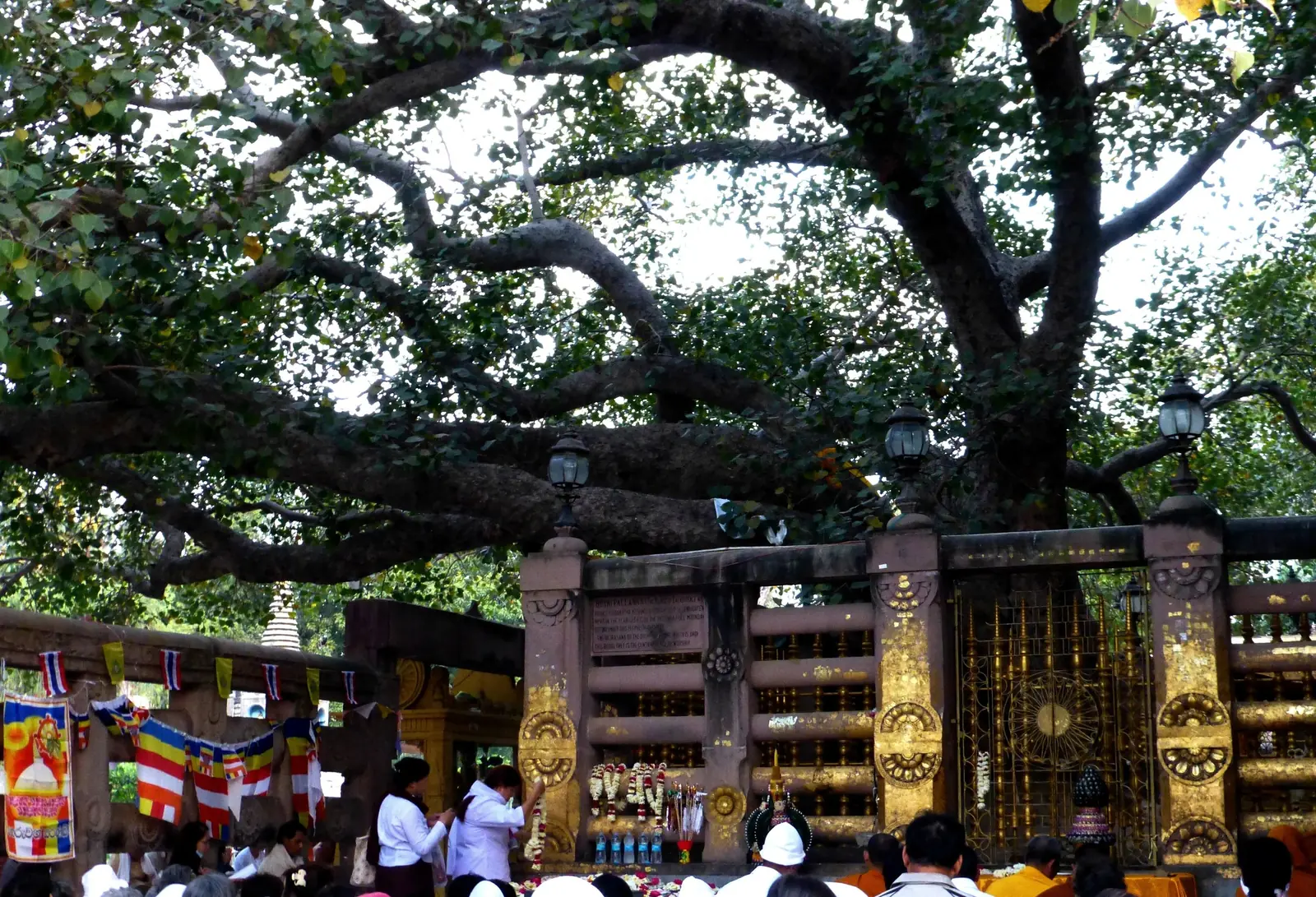
The Satipaṭṭhāna Sutta is the early discourse that many Vipassana traditions name as the source of their method. It describes four areas in which mindfulness is established: the body, feelings, the mind, and a set of teachings called dhammā. This page describes what the text says and how different traditions read it. It does not give meditation instructions; those come from a teacher.
Two versions of one discourse
Satipaṭṭhāna means the establishing, or foundation, of sati, mindfulness. Translators render the title in different ways: Bhikkhu Sujato as "Mindfulness Meditation", Thanissaro Bhikkhu as "Frames of Reference", and S. N. Goenka's discourses as the "Discourse on the Establishing of Awareness".
The text survives in two forms. The Satipaṭṭhāna Sutta is number 10 of the Middle Discourses (MN 10). The Mahāsatipaṭṭhāna Sutta, the longer version, is number 22 of the Long Discourses (DN 22). Both are set among the Kurus, at the town of Kammāsadhamma, and they are almost word for word the same. The difference is the section on the four noble truths: MN 10 covers it in one line, while DN 22 explains each truth in detail, including the whole Eightfold Path.
Both open by describing the four satipaṭṭhānas as ekāyano maggo. Sujato translates this as "the path to convergence" and Thanissaro as "the direct path". The stated purposes are to purify beings, to get past sorrow and lamentation, to end pain and distress, and to realise nibbāna. MN 10 closes by saying that anyone who develops the four in this way for seven years, or even for seven days, can expect one of two results: full awakening in this life or, if something remains, the stage of non-return.
The refrain repeated after every exercise
The sutta lists many exercises, and after each one it repeats the same passage.
The meditator is first described as ātāpī sampajāno satimā. Sujato translates this as "keen, aware, and mindful"; Thanissaro uses ardent, alert and mindful. The middle word is related to sampajañña, alertness or clear comprehension. The same line says the meditator is "rid of covetousness and displeasure for the world" (Sujato's wording).
After each exercise, the text then says that the meditator:
- observes the object internally, externally, and both;
- observes it arising (samudaya), vanishing (vaya), and both;
- is mindful simply that the body, feeling, mind or quality is there, as far as knowledge and mindfulness require;
- stays independent, not grasping at anything in the world.
Goenka's Day Ten discourse reads this refrain as a series of stations that every meditator passes through, whatever the starting point: first seeing arising and passing away separately, then together, and then bhaṅga, dissolution. Other traditions use their own maps of insight; the next guide sets out one of them.
Kāya: observing the body
The first foundation is kāya, the body. MN 10 gives six groups of exercises for observing it.
| Exercise | What MN 10 describes |
|---|---|
| Breathing | Knowing a long or short breath (Sujato: heavy or light), breathing while experiencing the whole body, and calming the bodily process |
| Postures | Knowing whether one is walking, standing, sitting or lying down |
| Clear awareness | Acting with awareness when going out and coming back, looking around, bending and stretching, dressing, eating and drinking, going to the toilet, speaking and keeping silent |
| Parts of the body | Reviewing the body from the soles of the feet up and the hair down as a list of 31 parts, from head hair to urine, like a person sorting a bag of mixed grains |
| Elements | Seeing the body as earth, water, fire and air, compared to a butcher who has cut up a cow and laid out the portions |
| Charnel ground | Comparing one's own body with a corpse at nine stages of decay, from bloated to bones crumbled to powder, and reflecting that one's body has the same nature |
The breathing steps also open the Ānāpānassati Sutta (MN 118), which sets out ānāpānasati, mindfulness of breathing, in 16 steps. MN 118 says that this one practice, fully developed, fulfils all four foundations. The practice as traditions teach it today is described at Anapana.
Vedanā: observing feelings
The second foundation is vedanā, feeling in the sense of pleasant, painful or neutral. MN 10 asks the meditator to know each feeling as it is felt: when feeling a pleasant feeling, to know "I feel a pleasant feeling", and the same for painful and neutral ones.
It then adds a second distinction. Each kind of feeling can be "of the flesh" or "not of the flesh" (the wording of both Sujato and Thanissaro), which makes nine kinds in all.
Translations differ on this word. Sujato and Thanissaro use "feeling". Goenka's tradition uses "sensation" and works with it as sensation in the body: dhamma.org describes Vipassana as "observing sensations throughout the body, understanding their nature, and developing equanimity by learning not to react to them".
Citta: observing the mind
The third foundation is citta, the mind. MN 10 lists sixteen states of mind in pairs, and the meditator knows which one is present:
- with greed or without greed; with hate or without; with delusion or without;
- constricted or scattered;
- expansive or unexpansive; supreme or not supreme;
- immersed in samādhi (concentration) or not;
- freed or unfreed.
The list asks the meditator to know the state, not to change it. Goenka's Day Ten discourse makes a similar point: it says the task is to stay aware of the nature of the mind at the moment, not to follow individual thoughts.
Dhammā: observing mental qualities
The fourth foundation is dhammā. Sujato translates the word here as "principles" and Thanissaro as "mental qualities". Under this heading the meditator looks at experience through five sets of teachings.
| Set | What MN 10 lists | What the meditator knows |
|---|---|---|
| The five hindrances | Sensual desire, ill will, dullness and drowsiness, restlessness and remorse, doubt | Whether each is present, how it arises, how it is given up, and how it does not arise again |
| The five aggregates | Form, feeling, perception, choices, consciousness | What each is, its origin and its disappearance |
| The six sense fields | Eye and sights, ear and sounds, nose and smells, tongue and tastes, body and touches, mind and ideas | The fetter that arises from each pair, how it arises, how it is abandoned and how it does not rise again |
| The seven awakening factors | Mindfulness, investigation of principles, energy, rapture, tranquillity, immersion, equanimity | Whether each is present, how it arises and how it is fully developed |
| The four noble truths | Suffering, its origin, its cessation, and the path to its cessation | Each truth as it really is; DN 22 explains every truth at length |
The Pali names for the first, second and fourth sets are nīvaraṇa, khandha and bojjhaṅga. In plain terms, this foundation turns attention to patterns in the mind: which qualities lead towards suffering and which lead away from it.
Where different traditions start
Modern teachers draw on the whole sutta, but their methods start from different foundations.
S. N. Goenka: sensations
Goenka's Day Ten discourse argues that observing the body means feeling it, so observation of the body involves observation of sensations. In the same way, observing the mind involves observing what arises in it, and whatever arises in the mind, the discourse says, is accompanied by a sensation in the body. The glossary of the Discourse Summaries concludes that all four foundations are included in the observation of sensations, and calls DN 22 the main source for the theory behind the practice.
On a 10-day course, students first spend about three days on ānāpāna, awareness of the breath, and then move to observing sensations throughout the body. The technique is taught on residential courses, with a teacher; this site describes it at Vipassana as taught by S. N. Goenka and body scanning. Old students who meet the requirements can later sit Satipaṭṭhāna Sutta courses, on which the recorded evening discourses examine the sutta in detail.
Mahasi Sayadaw: movements of the body, noted
Mahasi Sayadaw's method starts from the body. In his published instructions, the basic object in sitting is the rising and falling of the abdomen, noted silently as "rising" and "falling". Walking is noted in parts, and each movement in daily life is noted, including the intention before it.
Whatever else becomes prominent, such as a wandering thought or a pain, is also noted, so feelings and states of mind enter the practice too. Mahasi wrote that knowing the object matters more than knowing its name. See Mahasi noting and mental noting.
Sayadaw U Tejaniya: the mind
Sayadaw U Tejaniya teaches in the Shwe Oo Min lineage, which comes from Mahasi Sayadaw through Shwe Oo Min Sayadaw. His emphasis falls on the mind that is aware rather than on any one object. A whole category of his published teachings, "Attitude in Practice", is about the tone, quality and orientation of the mind rather than techniques or objects; one excerpt is titled "Thought is Mind Happening".
Spirit Rock Meditation Center describes him as treating right view in all activities as the heart of practice. See Shwe Oo Min awareness.
Western Insight Meditation centres
Spirit Rock, in California, says it uses the four foundations of mindfulness as the sequence of practice. Its teachers draw on Mahasi, U Ba Khin and Thai forest lineages; see Insight Meditation in the West.
The next guide, Impermanence, suffering and non-self, turns to the three characteristics that this observing of arising and passing away is meant to show.
Sources
- Satipaṭṭhāna Sutta: Mindfulness Meditation (MN 10), trans. Bhikkhu Sujato, SuttaCentral
- Mahāsatipaṭṭhāna Sutta (DN 22), trans. Bhikkhu Sujato, SuttaCentral
- Satipatthana Sutta: Frames of Reference (MN 10), trans. Thanissaro Bhikkhu, Access to Insight
- Ānāpānassati Sutta (MN 118), trans. Bhikkhu Sujato, SuttaCentral
- The Discourse Summaries (S. N. Goenka, condensed by William Hart), Vipassana Research Institute
- Vipassana Meditation, dhamma.org
- Course Glossary, dhamma.org
- Satipatthana Vipassana: Insight through Mindfulness (Mahasi Sayadaw), Access to Insight
- Attitude in Practice (Sayadaw U Tejaniya), Wisdom's Roar: Teachings of Sayadaw U Tejaniya
- Our Buddhist Lineage, Spirit Rock Meditation Center