
Loading…
Practice
Mindful walking on a short path: the Buddha's five benefits (AN 5.29), Mahasi's step-by-step noting, forest-tradition walking paths and basic guidance.
Walking meditation is mindful walking, usually back and forth on a short path, with attention on the feet and the movement of the body. In the Mahasi and Thai forest traditions it alternates with sitting through the day. Panditarama Lumbini, a Mahasi centre in Nepal, asks beginners to spend as much time walking as sitting, and forest teachers use it to develop the same meditation object in a different posture. Unlike the body-scanning of Goenka's courses, its basics are published openly by the traditions that teach it.
The Buddha praised walking meditation in the Caṅkama Sutta (AN 5.29), a short discourse in the Aṅguttara Nikāya. It lists five benefits: "You get fit for traveling, fit for striving in meditation, and healthy. What's eaten, drunk, chewed, and tasted is properly digested. And immersion gained while walking lasts long."
The Satipaṭṭhāna Sutta (MN 10) includes walking among the four postures to be known as they are: "when a mendicant is walking they know: 'I am walking.'" The same attention applies to standing, sitting and lying down. See the four foundations of mindfulness.
The Thai forest teacher Ajahn Nyanadhammo writes that the place where the Buddha walked in meditation at Bodh Gaya after his awakening still exists, and that the path was seventeen steps long.
In Mahasi Sayadaw's method, walking is noted like everything else. His manual Satipatthana Vipassana asks for attention on the sole of the foot as it moves, from lifting to placing, and builds up the detail gradually. The next step should begin only after the first is complete. Chanmyay Sayadaw U Janaka, who trained under Mahasi, divides each step further.
| Stage | What is noted | Source |
|---|---|---|
| One part | "right step, left step", or "walking, walking" | Mahasi Sayadaw |
| Two parts | "lifting, placing" | Mahasi Sayadaw |
| Three parts | "lifting, moving, placing", after two or three days | Mahasi Sayadaw |
| Six parts | intending, lifting; intending, raising (the toes); intending, pushing; intending, dropping; touching; intending, pressing | Chanmyay Sayadaw |
Chanmyay Sayadaw explains that touching is not preceded by an intention, because the foot touches the ground as soon as it drops. He suggests spending the first ten minutes or so of each walking period noting left and right, and keeping steps short, about the length of a foot.
On Mahasi retreats walking alternates with sitting. Panditarama Lumbini in Nepal asks meditators to alternate an hour of sitting with an hour of walking, or about 45 minutes of each for beginners, on a path of 5 to 7 metres. See mental noting for the method as a whole.
Forest monasteries give walking a large share of the day. Ajahn Nyanadhammo's booklet Walking Meditation, published by Wat Pah Nanachat in 2003, describes the practice as it is taught there:
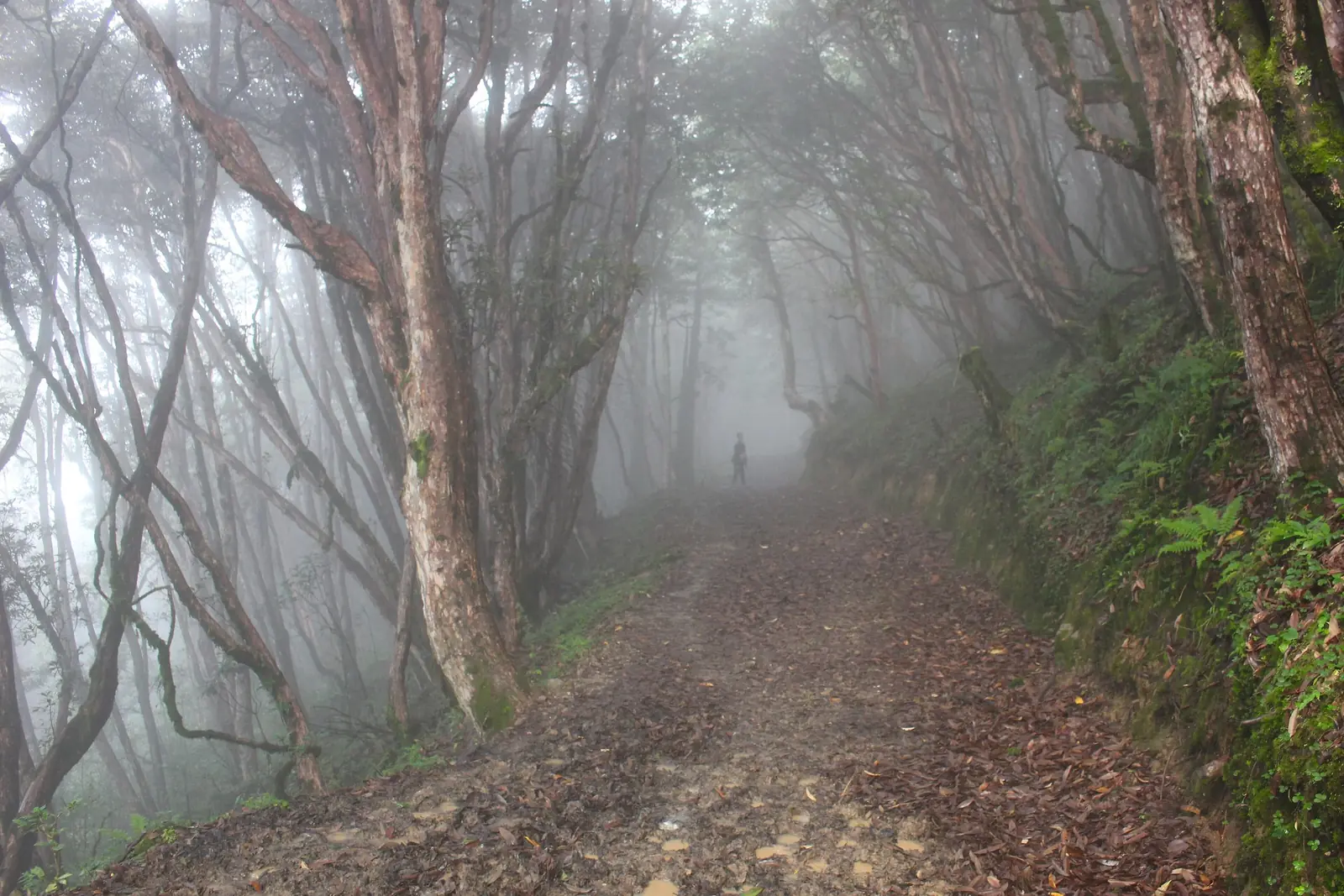
Walking meditation is one of the practices that teachers describe openly for beginners. The points below combine the published guidance of Ajahn Nyanadhammo and Panditarama Lumbini; where they differ, both are given.
The meditation timer on this site can time a walking period as well as a sit.
In Nepal, walking meditation is taught on retreat at the Mahasi centres Panditarama Lumbini and the International Buddhist Meditation Center in Kathmandu. At Thai forest monasteries such as Wat Pah Nanachat, which does not run courses, guests follow the monastic routine and spend much of the day in sitting and walking meditation.