
Loading…
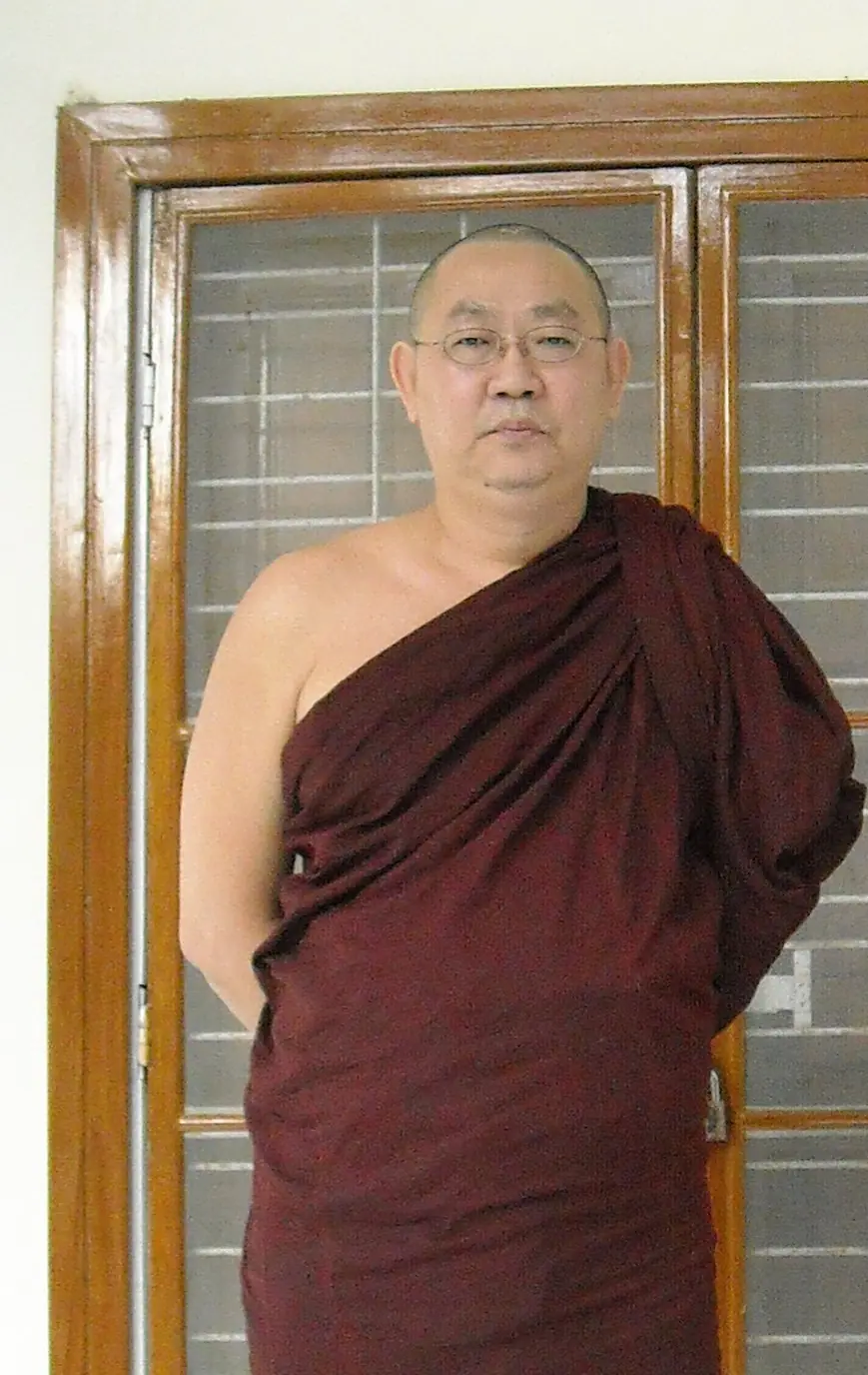 Photo: Kumara Bhikkhu, CC BY 3.0
U Tejaniya (Shwe Oo Min) · 1962
Burmese monk and former businessman who teaches relaxed, continuous awareness of the mind in daily life
Sayadaw U Tejaniya is a Burmese monk who teaches at the Shwe Oo Min Dhamma Sukha forest centre on the outskirts of Yangon. His teaching is less concerned with which object a meditator attends to than with the attitude of the mind that is doing the attending. His official website uses the name Ashin Tejaniya.
U Tejaniya began practising in his early teens under Shwe Oo Min Sayadaw, and ordained several times as a novice while still young. He then lived as a householder and ran a business before taking the robe for good in 1996. His official site dates his birth to 1962: students marked his 50th birthday in 2012.
Practice in ordinary life is central to what he teaches. His books describe practice "in everyday life", and the site that collects his talks has a separate section on daily-life practice alongside the material on formal sitting and walking.
His teacher, Shwe Oo Min Sayadaw (Ven. Kosalla), was born on 15 September 1913 in Mon State and died in 2002. He trained under Mahasi Sayadaw, who appointed him a meditation teacher in 1951. U Tejaniya's line is therefore a branch of the Mahasi noting tradition, though its emphasis differs, as the sections below show.
Shwe Oo Min Sayadaw started the forest centre north of Yangon in 1998, and U Tejaniya now teaches there: see Shwe Oo Min Dhamma Sukha Tawya. The collection of his teachings also names the Dhammavibhajja centre in Yangon as a place where he teaches.
The core of his teaching is what he calls right attitude. A booklet of that name sets out 23 points "to help establish a right attitude for practice". Wisdom's Roar, the site of his collected teachings, has a whole category on attitude in practice, concerned with the tone, quality and orientation of the mind rather than with techniques or objects.
The titles of some of his published excerpts state the approach plainly:
The aim is relaxed, continuous sati in every posture and activity, not a tight focus on one spot. The classical Mahasi method starts from a set primary object, the rising and falling of the abdomen, and labels each experience (see mental noting). U Tejaniya's instructions put more weight on the continuity and quality of awareness itself.
He treats greed, aversion and delusion, the kilesa or defilements, as things to learn from rather than to push away. An excerpt titled "Watch the Defilement to Understand, Not to Make It Go Away" makes the point directly. His booklet Don't Look Down on the Defilements, They Will Laugh at You covers right attitude, the right effort of continuity, meditation as mind work, and how to work with pain, posture, sounds and the wandering mind.
Investigating what is happening in the mind is part of the practice. Spirit Rock Meditation Center in California names him as one of the more recent influences on Western insight teachers, and says he "emphasizes right view in all activities as the heart of practice".
The retreat page on his official site describes a simple routine: rising at 3.30 am, the shrine room at 4 am, two meal breaks, and alternating hours of sitting and walking until 9 pm. A talk or semi-guided meditation runs from 9 to 10 am, and yogis meet in the Sayadaw's kuṭi for group Dhamma discussion about every five days. Much of the teaching happens through questions and answers.
Yogis keep eight precepts, or at least five with the teacher's permission. Chairs are allowed, and practice in one's own room is often fine. Foreigners may stay for up to three months, but only while the Sayadaw is present, which has usually meant the rains retreat. The centre says its facilities, teachings, CDs and publications are free of charge, and that visitors may offer a meal or make other donations if they wish.
Several of his books, including Awareness Alone Is Not Enough and Dhamma Everywhere, are printed for free distribution. Shambhala published When Awareness Becomes Natural in 2016. The practice and the centres where it is taught are described on the Shwe Oo Min awareness page.