
Loading…
Thai Forest · 1918–1992
หลวงพ่อชา
Thai forest master whose plain teaching and Western disciples carried the Forest tradition abroad
Ajahn Chah was a Thai forest monk whose monastery in Ubon Ratchathani, in north-east Thailand, drew a growing number of Western students from the late 1960s. Through them his teaching reached Britain, continental Europe, Australia, New Zealand and North America.
Chah was born on 17 June 1918 into a farming family in a village in Ubon Ratchathani province. As a boy he spent three years as a novice in the village monastery, where he learned to read and write and studied basic Buddhist teachings. On 26 April 1939, at the age of twenty, he returned to monastic life for higher ordination as a bhikkhu.
For his first few years as a monk he studied Dhamma, the monastic discipline, the Pali language and the scriptures. In 1946 he gave up formal study and set out as a wandering monk.
During his travels he went to meet Ajahn Mun, whom ajahnchah.org calls a most highly respected meditation master, and spent "a short but enlightening period" with him. Spirit Rock Meditation Center records the advice Ajahn Mun gave him:
"turn back to see who is being aware, become the One Who Knows"
For the next seven years Chah lived as an ascetic monk in the austere style of the forest tradition.
In 1954 he was invited to settle in a forest grove near the village where he was born. Spirit Rock describes the place as "fever-ridden, haunted". The community that grew there became Wat Nong Pah Pong, and ajahnchah.org says more than two hundred branch monasteries in Thailand now follow its way of practice.
The daily round in his monasteries is built on the monastic code. At Wat Pah Nanachat, the branch for Westerners, monks eat one meal a day, in one bowl, at one sitting, and the day moves between chanting, chores and sitting and walking meditation. Lay guests there follow the same routine on eight precepts.
His published talks describe breath meditation in simple terms. The meditator should not force the breath but "just note it". He suggested first noticing the breath at three points (the tip of the nose, the chest and the abdomen), then letting those go and noting the breath at one point only as it enters and leaves. He treated sitting and walking as equal, writing that they "are in essence the same, differing only in terms of the physical posture used".
The practices themselves are described on the ānāpāna and walking meditation pages.
The first Westerner to stay at Wat Nong Pah Pong was the American monk Sumedho, later Ajahn Sumedho. The biography on ajahnchah.org dates his arrival to 1966, while Spirit Rock gives 1967. By 1969 a few more Western monks had come, Jack Kornfield among the first.
In 1975 Wat Pah Nanachat, the International Forest Monastery, was set up in a nearby forest as a training monastery for Westerners, with Sumedho as its first abbot. In 1977 Ajahn Chah and Ajahn Sumedho were invited to Britain, and Chah returned there in 1979. That year his senior Western disciples founded the first of the European branch monasteries, Cittaviveka, in West Sussex. He also visited the Insight Meditation Society in Massachusetts.
Today communities in his line exist in Thailand, England, Switzerland, Italy, France, Australia, New Zealand, Canada and the United States, according to ajahnchah.org.
In 1980 he began to suffer more acutely from dizziness and lapses of memory. An operation in 1981 did not stop the illness, and he spent about the last ten years of his life paralysed and unable to speak.
He died on 16 January 1992. Spirit Rock records that more than a million people, including members of the Thai royal family, attended his funeral.
His talks were recorded, transcribed and translated, and many are free to read on ajahnchah.org. A Still Forest Pool, compiled by Jack Kornfield and Paul Breiter, was published in 1985. His tradition and its monasteries are described on the Thai Forest tradition page.
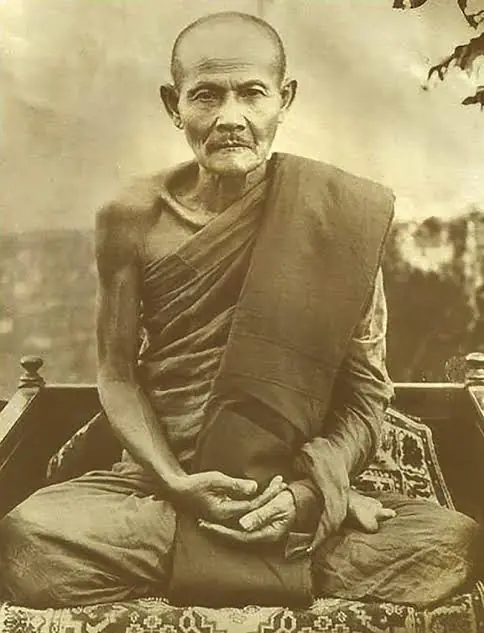
1870–1949 · Thailand
Wandering Thai monk who, with his teacher Ajahn Sao, established the Thai Forest (Kammatthana) tradition
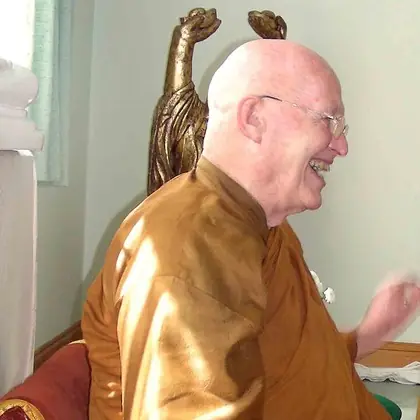
b. 1934 · United Kingdom
American-born disciple of Ajahn Chah and founding abbot of Cittaviveka and Amaravati monasteries in England