
Loading…
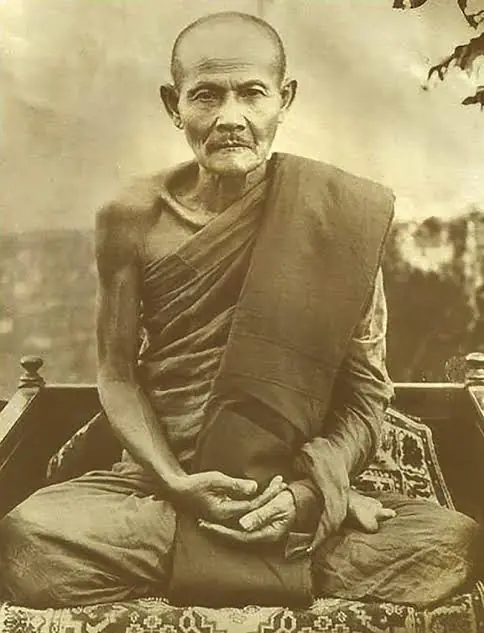 Photo: Unknown author, Public domain
Thai Forest · 1870–1949
มั่น ภูริทตฺโต
Wandering Thai monk who, with his teacher Ajahn Sao, established the Thai Forest (Kammatthana) tradition
Ajahn Mun Bhūridatto was a Thai monk who spent most of his monastic life wandering and meditating in the forests of Thailand, Laos and Burma. With his teacher, Ajahn Sao Kantasīlo, he established the Kammaṭṭhāna, or forest meditation, tradition, which later spread across Thailand and abroad. Ajahn is the Thai word for teacher, from the Pali ācariya.
Mun was born in 1870 in Ban Kham Bong, a farming village in Ubon Ratchathani province in north-east Thailand. He was ordained as a monk in 1893. From then until his death he lived as a wandering monk, moving between Thailand, Burma and Laos and staying mostly in the forest.
His teacher was Ajahn Sao Kantasīlo (1861–1941). Access to Insight credits the two of them together with founding the Kammaṭṭhāna tradition, which "subsequently spread throughout Thailand and to several countries abroad".
The Forest Sangha, the network of monasteries in Ajahn Chah's line, says that almost all of the revered forest masters of twentieth-century Thailand trained with Ajahn Mun. The tradition treats monastic life itself as the practice: the full monastic code of 227 rules, celibacy, eating only between dawn and noon, not handling money, and tudong, wandering on foot through the countryside.
According to Buddho.org, Ajahn Mun kept many of the thirteen dhutaṅga, or ascetic practices. They included eating only food received on alms round, wearing robes made from discarded cloth, living in the forest and eating one meal a day.
Within the tradition he is widely regarded as an arahant, a fully liberated being. Spirit Rock Meditation Center's lineage page says he was "widely considered to have attained liberation and become an arahant". That is a statement of the tradition's belief, and it is reported here as such.
Among those who trained with him was Ajahn Chah, who spent what ajahnchah.org calls "a short but enlightening period" with him. Spirit Rock records the advice Ajahn Mun gave him: to turn back and see who is aware, and to become "the One Who Knows". Ajahn Lee Dhammadharo, author of the breath-meditation manual Keeping the Breath in Mind, was another of his students.
The forest tradition does not usually separate calm from insight. Thanissaro Bhikkhu, the translator of A Heart Released, argues in his essay "One Tool Among Many" that in the suttas samatha and vipassanā "are not separate paths of practice". See Samatha and Vipassana for more on the two terms.
Most of what survives of his teaching was written down by others. A Heart Released, translated by Thanissaro Bhikkhu, gathers seventeen short excerpts from teachings he gave in 1944–45, compiled by Ajaan Suwat. Other fragments appeared in a volume distributed at his cremation in 1950, and Access to Insight also publishes a teaching poem he composed in the 1930s. A spiritual biography of him by the forest teacher Ajahn Mahā Boowa is available in English.
Ajahn Mun died in 1949 at Wat Suddhavasa in Sakon Nakhon province, and he was cremated in 1950. His line continues in the forest monasteries of Thailand and in monasteries founded by Ajahn Chah and his Western students, among them Wat Pah Nanachat in Thailand and Amaravati in England. The practice and its monasteries are described on the Thai Forest tradition page.
1918–1992 · Thailand
Thai forest master whose plain teaching and Western disciples carried the Forest tradition abroad
b. 1934 · United Kingdom
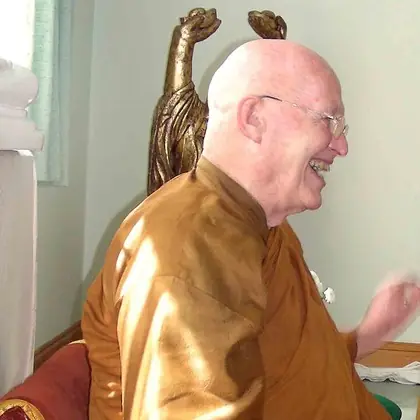
American-born disciple of Ajahn Chah and founding abbot of Cittaviveka and Amaravati monasteries in England