Global Vipassana Pagoda, Mumbai: history, dome and how to visit
The Global Vipassana Pagoda at Gorai, Mumbai: why S. N. Goenka built it, how its pillarless stone dome was made, and how to visit, meditate and get there.
Vipassana Nepal team · · 8 min read
The Global Vipassana Pagoda is a gilded stone monument at Gorai, on the north-western edge of Mumbai, built by students of S. N. Goenka as a meditation hall and a thank-you to Myanmar (Burma) for preserving Vipassana. Inside is a single hall for about 8,000 meditators under one of the largest stone domes ever built without pillars. Visitors can enter free of charge, every day from 9 am to 7 pm (as of September 2026).
This guide covers why it was built, how the dome was made, what a visitor can do there and how to reach it. The facts come from the pagoda's own website, globalpagoda.org, and the Vipassana Research Institute (VRI), unless the text says otherwise.
What the Global Vipassana Pagoda is
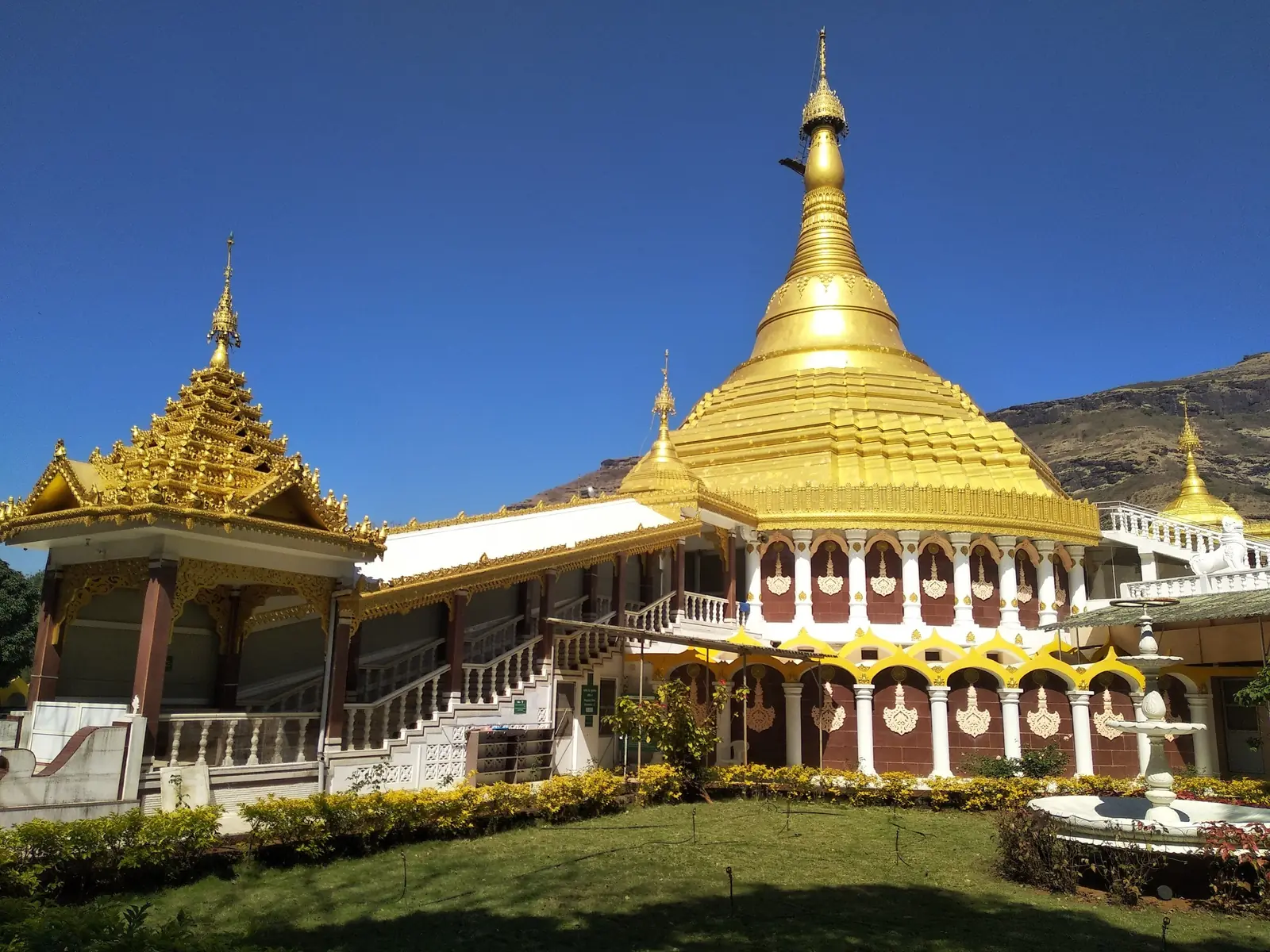
The pagoda stands on a hill near Gorai creek, next to the Esselworld amusement park, in the Borivali (West) area of Mumbai. It is run by the Global Vipassana Foundation and belongs to the tradition of S. N. Goenka, who learned Vipassana in Burma from Sayagyi U Ba Khin and began teaching it in India in 1969.
It has three jobs, according to its mission page:
- A place to meditate. The hollow main dome is a meditation hall where Goenka's students can sit together in large numbers.
- A shrine. Bone relics of the Buddha are enshrined in the dome.
- An explanation. Galleries present the Buddha as a historical person and explain Vipassana to visitors who have never meditated.
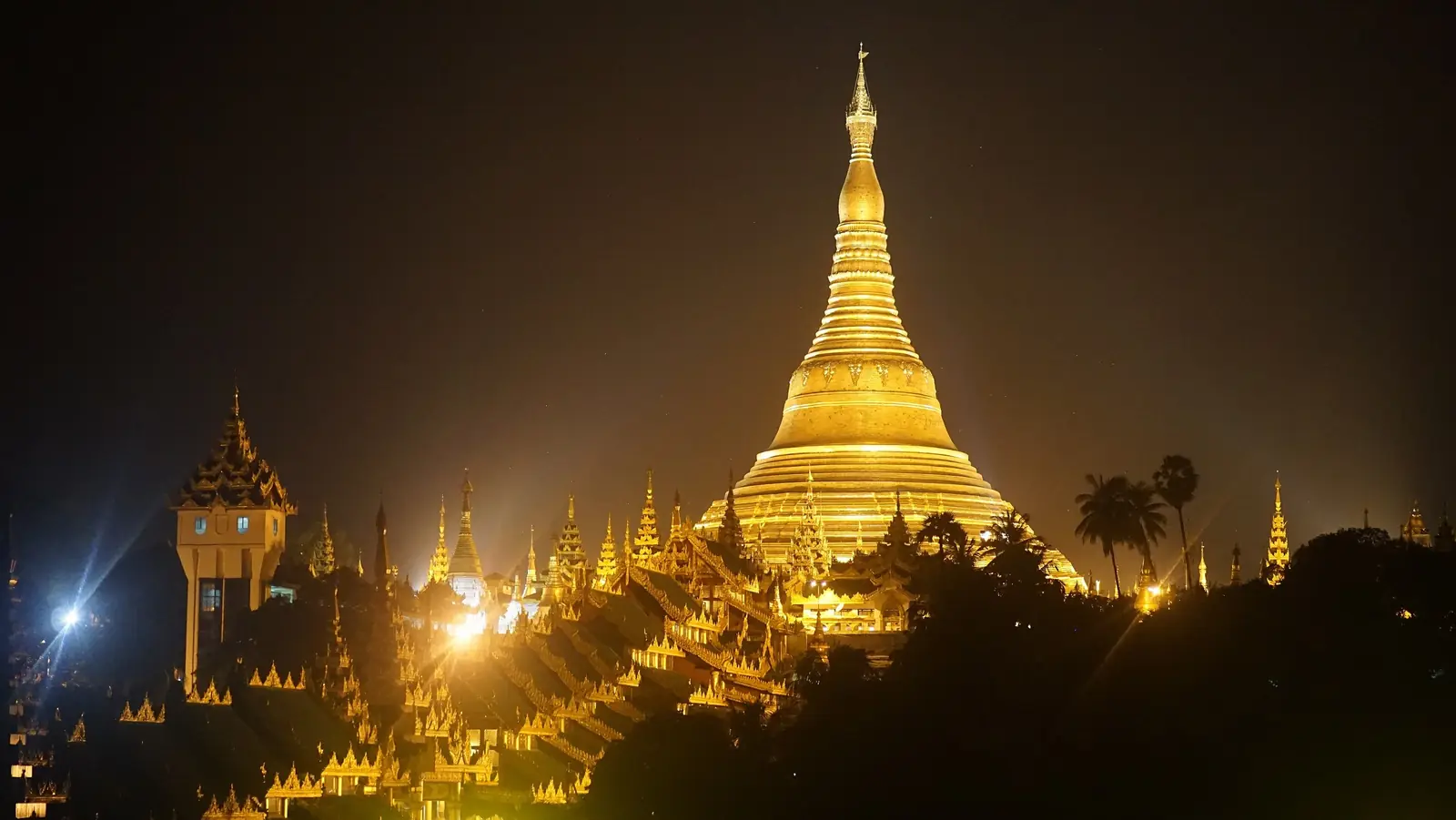
The foundation describes the building as a replica of the Shwedagon Pagoda in Yangon, and its vision page calls it "an expression of gratitude to Myanmar, the country that preserved Vipassana".
Why it was built
Goenka taught that Vipassana, the practical core of the Dhamma, had been lost in India for centuries and kept alive in Burma by a chain of teachers and monks. The pagoda was built to mark that debt. Its mission page says people who see it will "remember the kindness of that country with gratitude", and its vision page names Sayagyi U Ba Khin, Goenka's teacher, as the one "who enabled each of us today to find the path to liberation".
Most pagodas are solid. This one was designed hollow so that thousands of Goenka's students could sit together under the relics. The relics were originally found at Bhattiprolu in Guntur district, Andhra Pradesh. They were donated by the Mahabodhi Society of India and by Sri Lanka: one of the foundation's pages says the Prime Minister of Sri Lanka, another says the Government of Sri Lanka.
Construction: from 1997 to 2009
| Date | What happened |
|---|---|
| October 1997 | Foundation stone laid on the Essel plateau |
| 2000 | Building work began |
| 29 October 2006 | Buddha relics enshrined in the dome |
| 21 November 2008 | Third dome structurally completed |
| 21 December 2008 | First one-day course in the hall, with Goenka present |
| 8 February 2009 | Inaugurated by the then President of India |
The building took 11 years from the foundation stone to completion in November 2008. The foundation says the work was paid for by donations from meditators and supporters around the world and was never interrupted. Dhamma Pattana, a residential centre for 10-day courses inside the complex, opened in 2007 (VRI).
In 2013 the Maharashtra Tourism Development Corporation and the Marathi news channel ABP Majha named the pagoda one of the "Seven Wonders of Maharashtra", the foundation's home page reports.
The pillarless dome and its size
The main hall sits under a dome built from interlocking stones with no supporting pillars. According to the foundation:
- The building is 96.12 metres tall, according to the concept page. The facts page gives 325 feet (about 99 metres) and adds that it is "almost as tall as a 30 storey building".
- The dome's internal diameter is 85.15 metres (about 280 feet), and the hall inside covers more than 6,000 square metres.
- The hall seats over 8,000 people.
- The pagoda has three domes stacked one above the other. The first and largest is the hall.
How the stones hold each other up
Each stone has grooves cut in both horizontal and vertical directions, so it locks into its neighbours in both. The foundation says a ring of stones is secure only once the whole circle is complete, and that the more weight is added, the more firmly the stones grip each other. Most of the stones weigh about 600 to 700 kg, and the builders placed them without temporary supports. The keystone at the top weighs 10 tonnes.
The stone came from Rajasthan, more than a thousand kilometres away. The foundation and base are black basalt, while the inner dome and the serrated outer surface are Jodhpur stone, set in lime mortar. The architect was Parvez Dhumasia, with structural design by Nandadeep Building Centre, Aurangabad, and research that included a study by the Indian Institute of Technology in Mumbai. The stated aim was a building that would last a thousand years, which is why stone was chosen over reinforced concrete.
Where the relics are
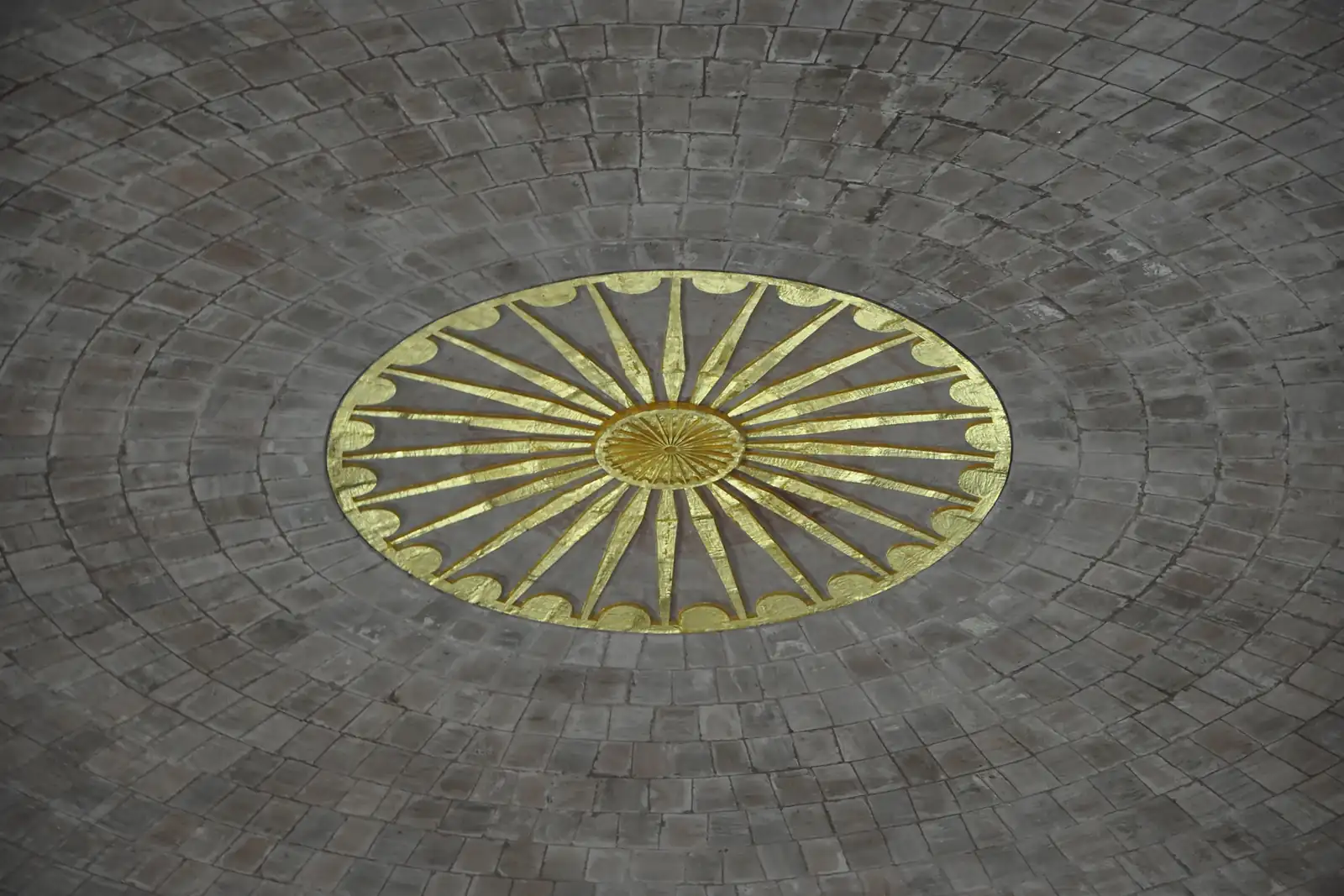
Look straight up from the centre of the hall and you see a gilded Dhamma wheel at the apex of the dome, the scene in the photograph at the top of this page. The foundation describes the relics' place in two slightly different ways: one page says they sit in the central locking stone of the dome, and another says they are in the second dome, directly above that wheel.
What visitors can do
As of September 2026, the pagoda's website says it is open every day from 9 am to 7 pm. There is no entry fee and no charge for the tour guides. Hours and rules change, so check globalpagoda.org before you go.
Seeing the dome
Only "old students", people who have completed a 10-day course with S. N. Goenka or one of his assistant teachers, may enter the dome and meditate. Everyone else can look into the hall from the visitors' gallery, where free information leaflets are handed out. Photography and video are not allowed inside the main dome or the visitors' gallery; they are allowed elsewhere on the site.
A first taste of meditation: Mini-Anapana
Visitors aged over 10 can join a free session of Anapana, awareness of the natural breath, in the North Pagoda, opposite the visitors' gallery. The site lists sessions running continuously from 10 am to 6.30 pm. The instructions are a recording in Goenka's voice: about ten minutes of breath awareness, twenty minutes in all with the closing mettā. You sit in silence with your phone switched off, men and women in separate areas, and you stay for the whole session. You watch the natural breath without repeating a word or picturing a form. For more on this practice, see Ānāpāna: awareness of breathing.
Galleries and the rest of the complex
The foundation's list of places to see includes:
- a video gallery with free 17-minute films in Hindi and English on the pagoda and Vipassana;
- a painting gallery of stories from the Buddha's time, with audio in Goenka's voice;
- a photo gallery of the construction;
- the Myanmar Gate, a bell tower and a gong tower in Burmese style, and a large Buddha statue carved from a single block of marble;
- a food court and a book and souvenir shop.
The home page notes that "The Journey of Dhamma" experiential gallery opens on weekends and holidays from 1 pm to 5 pm (as of 2026).
Rules for visitors
These are the pagoda's own rules, as posted on its website in 2026:
- Dress: no shorts or skirts above the knee, and no bare shoulders.
- Food: since 1 March 2024, no outside food is allowed on the campus; food courts on site sell meals.
- Intoxicants: no alcohol, cigarettes, bidis, paan, mawa, pan masala or chewing tobacco.
- ID: foreign visitors must carry identity proof, such as a passport.
Meditating there: one-day and 10-day courses
The pagoda holds one-day courses for old students. The booking site, oneday.globalpagoda.org, showed courses on most days in September 2026, from 11 am to 5 pm, plus occasional larger "mega" one-day courses. Registration is required. Daily one-day courses began on 3 July 2018, the start of the fiftieth year since Goenka's first course in Mumbai.
First-timers cannot join these. To learn the technique you sit a 10-day residential course, which is free, with food and lodging paid for by donations from earlier students. Inside the same complex, Dhamma Pattana runs 10-day courses mainly for business executives and professionals, in air-conditioned rooms. Dhamma Giri at Igatpuri, about 136 km from Mumbai, is one of the tradition's largest centres. For what a course involves, read the 10-day course, day by day.
How to reach the Global Vipassana Pagoda
The pagoda's "Reaching the Pagoda" page gives these routes. Timetables and fares change, so check them before you travel.
By road from central Mumbai or the airport. Take the Western Express Highway north towards Dahisar, past the Dahisar toll booth. At the Mira-Bhayandar crossing, marked by a statue of Shivaji Maharaj, turn left towards Mira-Bhayandar, then follow signs to Esselworld and the Global Vipassana Pagoda. The pagoda is about 42 km from the domestic airport terminal. Coming from Thane, Nashik, Pune or Navi Mumbai, use Ghodbunder Road to the same Mira-Bhayandar crossing.
By train, bus and ferry. Take a Western Railway suburban train to Borivali and leave on the west side. From there, BEST buses 294 and 247 or an autorickshaw go to Gorai Creek, about 3.8 km away. Cross the creek by ferry: the Esselworld ferry lands at the Esselworld jetty, a short signposted walk from the pagoda, while the local ferry lands farther away in Gorai village. Dhamma Pattana's directions add that Borivali West also has a Metro station (Line 2A from DN Nagar, or Line 7 from the airport side).
From Bhayandar. From Bhayandar station (west), Mira Bhayandar Municipal Transport bus route 4 goes to the pagoda.
For the centre's details, map and sources, see the Global Vipassana Pagoda page in the centre directory, and the other Vipassana centres in India, with every centre's phone number and email in Vipassana centres in India by state.
Sources
- Facts and Figures, Global Vipassana Pagoda
- Concept and Planning of Global Vipassana Pagoda, Global Vipassana Pagoda
- Construction and Development, Global Vipassana Pagoda
- Enshrining the relics, Global Vipassana Pagoda
- Vision behind Global Vipassana Pagoda, Global Vipassana Pagoda
- Mission of the Global Vipassana Pagoda, Global Vipassana Pagoda
- Global Vipassana Pagoda (home page: visitor notices, Mini-Anapana rules), Global Vipassana Pagoda
- Places at Global Vipassana Pagoda, Global Vipassana Pagoda
- Reaching the Pagoda, Global Vipassana Pagoda
- One-day course schedule, Global Vipassana Pagoda, Global Vipassana Pagoda
- Timeline, Vipassana Research Institute
- About us, Dhamma Pattana