
Loading…
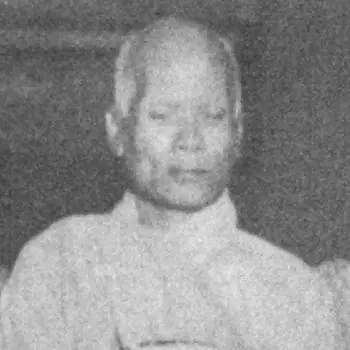 Photo: Unnamed photographer, Chaṭṭa Sangāyanā Souvenir Album, Rangoon 1956 (uploaded by Zenwort), Public domain
Teacher · 1900–1993
भिक्षु प्रज्ञानन्द महास्थविर
First Theravāda monk in robes seen in modern Kathmandu (1930), and later the first Sangha Nayaka of Nepal.
Bhikkhu Pragyananda was one of the three founders of the Theravāda revival in Nepal, with Mahapragya and Dhammalok. When he entered Kathmandu in 1930 he was celebrated as the first "pure Buddhist monk" in ochre robes to walk its streets since the late fourteenth century. He lived to become the first Sangha Nayaka, the senior monk of Nepal's Theravāda order.
He was born Kul Man Singh Tuladhar in 1900 in Itum Baha, Kathmandu. Like many Newar merchants of his day he traded in Tibet, and in Lhasa he worked as a healer. There he treated Mahapragya, a Nepali who had become a monk in the Tibetan tradition and had fallen ill, and Mahapragya persuaded him to give up lay life, including the wife and child he had in Tibet. He became a Tibetan monk with the name Karmasheel (LeVine and Gellner).
After eleven months meditating in a cave near Shigatse, the two men set out on pilgrimage to India. At Kushinagar they put themselves under Chandramani, a Burmese monk who lived at the site of the Buddha's death, and were ordained as Theravāda novices. Pragyananda's biography, as summarised by LeVine and Gellner, gives two reasons: an overwhelming experience in front of the statue of the reclining Buddha, and Chandramani's argument that Nepalis would find it easier to learn the Buddha's teaching in Pali than in Tibetan. Sources differ on the year: 1928 in some accounts, 1930 in LeVine and Gellner's.
In 1930 he crossed into Nepal alone, because Mahapragya, already expelled once, could not enter openly. LeVine and Gellner report the claim that he was the first ochre-robed monk in Kathmandu since the late fourteenth century, and the 2025 Tribhuvan University study calls him the first yellow-robed monk to appear in the valley. The fourteenth-century date comes from a local tradition that King Jaya Sthiti Malla abolished celibate monasticism; LeVine and Gellner point out that non-Mahayana monasticism had almost certainly died out in the valley long before his reign. The Tribhuvan University study adds that Pragyananda was arrested, jailed and fined for his conversion before being released. In 1931 he and Mahapragya went to Burma, where they received full ordination the following year, and he took the name Pragyananda.
In 1930 he gave the Eight Precepts at a Buddhist fasting ceremony at Kindo Baha, below Swayambhu, organised by Dhammalok. Three women who took part were inspired to become the first Theravāda nuns of modern Nepal, and the group of women taught by Dharmachari Guruma went to hear him and Mahapragya preach.
From 1943 he was abbot of Sumangal Vihara in Lalitpur, and in 1949 he moved to Shakyasingha Vihara, also in Lalitpur. He taught young people the basics of debate, which he had learned as a monk in Tibet, and spent much time in the village of Balambu, which became a stronghold of Theravāda Buddhism. In 1956 he introduced a Theravāda alternative to the Newar boys' coming-of-age rite, in which boys spend a few days at a monastery as novices (LeVine and Gellner). He also wrote devotional hymns, and the Tribhuvan University study credits him with publishing the first collection of Buddhist hymns for the Gyanmala singing groups.
In 1944 he was one of eight monks and novices in Kathmandu and Lalitpur who refused to sign an undertaking to stop teaching and ordaining. Prime Minister Juddha Shamsher exiled them to India, where they founded the Dharmodaya Sabha at Sarnath in November 1944. They were allowed back in 1946 after a goodwill mission from Sri Lanka arranged by Amritananda. After the Rana regime fell, the Sabha opened a Kathmandu branch at Shrigha Vihara with Pragyananda as president (LeVine and Gellner).
The head of Nepal's monastic community, the Sangha Nayaka, is its most senior monk by ordination, and Pragyananda was the first to hold the post (LeVine and Gellner; Kantipur). After Amritananda died in 1990 he also became president of the All-Nepal Bhikkhu Mahasangha.
In January 1984 he gave the sermon at an ordination of new novices at Manimandap Vihara in Lalitpur, the monastery founded by Bhikkhu Gyanapurnik. For his eighty-fifth birthday, 85 young men took temporary ordination and spent a week in study and meditation at Shri Kirti Vihara in Kirtipur, where a gold-leafed statue of him stands. He died in 1993. The later arrival of Vipassana in Nepal is told in Vipassana in Nepal: a short history.