Loading…
Teacher · 1901–1979
भिक्षु महाप्रज्ञा
Hindu-born Newar monk expelled by the Ranas in 1926 and one of the first Theravāda monks of modern Nepal.
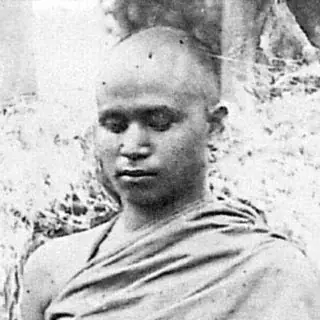
Mahapragya was one of the first Nepalis to become a Buddhist monk in the twentieth century and, with Pragyananda, one of the first two Theravāda monks to appear in Nepal, in 1930. Kantipur calls him Nepal's first Theravāda bhikkhu. The Rana government expelled him in 1926 and jailed him again in the 1930s. He later left the monkhood, but came back to Kathmandu in the 1960s as a Buddhist sage, बौद्धऋषि (Bauddha Rishi), and taught there until his death.
He was born Prem Bahadur Shrestha in Kathmandu in 1901 and was known in his youth as Nani Kaji. His family were Hindus: his parents had moved from Bhaktapur, and his father became caretaker of a Hindu temple (LeVine and Gellner; Kesar Lall describes them as Shivamargi Newars). He trained as a tailor, but his passion was music. After reading Nisthananda Vajracharya's Nepal Bhasa version of the Lalitavistara, a life of the Buddha, he began composing Buddhist hymns.
In 1924 he heard the Tibetan teacher Kyangtse Lama preach at Kindo Baha, below Swayambhu, and resolved to become a monk. He followed another lama towards Tibet and was ordained a Nyingma novice at Kyirong, taking the name Mahapragya. Back in the Kathmandu valley he lived on Nagarjun hill with a Tibetan lama, Tsering Norbu, together with four other young Newars who had also become novices. The five went on alms rounds among the city's Buddhists. The poet Chittadhar Hridaya later recalled people weeping at the sight of monks in the long-forgotten ochre robe (LeVine and Gellner).
In 1926 the government, prompted by Vajracharya priests who objected that a Shrestha, presumed Hindu by birth, had converted, expelled all five novices and Tsering Norbu to India (LeVine and Gellner). Kloppenborg records that he was expelled with five others "on the accusation of causing communal disturbances".
At Bodh Gaya and in Calcutta the exiles met Theravāda monks and the reformers of the Maha Bodhi Society. Mahapragya went on to Lhasa, where he took full Tibetan ordination and taught, and where a Nepali healer, Kul Man Singh Tuladhar, nursed him through an illness. Mahapragya persuaded him to become a monk, and the two travelled together to Kushinagar, where the Burmese monk Chandramani ordained them as Theravāda novices. Kesar Lall and a 2025 Tribhuvan University study date his Theravāda ordination to 1928.
In 1930 Kul Man Singh, now a Theravāda novice and later known as Pragyananda, entered Nepal first. Mahapragya, as an expelled man, slipped past the police post at Thankot disguised as a woman. In 1931 the two went to Burma, and they received full ordination there the following year (LeVine and Gellner).
In Kalimpong in the mid-1930s he taught Pali to the young novice Amritananda. When the two went to Bhojpur in eastern Nepal, the local governor recognised Mahapragya as an expelled monk, and both were held in jail for four months before being escorted back to India (Kesar Lall; the Tribhuvan University study dates this to 1937). Between his ordination and the Second World War he travelled back and forth between Nepal and Burma and spent long periods meditating in the jungle. In 1944 he sat on the first committee of the Dharmodaya Sabha, the society founded by the monks exiled that year.
While waiting in Kalimpong in 1945 to be allowed back into Nepal, he disrobed and married. For years he earned his living as a photographer, while teaching Buddhism among Kalimpong's Newars and writing for the journal Dharmodaya as M. P. Pradhan. In 1962 he returned to Kathmandu. A monk who has broken the rule of celibacy is pārājika, "defeated", and cannot be readmitted to the Sangha, so he called himself a Buddhist sage rather than a bhikkhu and wore a maroon Tibetan-style robe.
Devotees built him a small retreat in Bag Bazaar, Kathmandu, later known as Dharmachakra Vihara, and he remained a lively preacher, teacher and composer of devotional songs with many followers. He was paralysed in 1971 and died in 1979 (LeVine and Gellner). His autobiography was published in 1983. How the revival he helped start later turned to meditation is told in Vipassana in Nepal: a short history.