What is Dhamma? The meaning of Dhamma in Buddhism
Dhamma, Sanskrit dharma, is the Buddha's teaching and the truth it points to. Its main meanings, the three jewels, and how it differs from Hindu dharma.
Vipassana Nepal team · · 6 min read
In Buddhism, Dhamma means the teaching of the Buddha, and also the truth about how things are that the teaching describes. It is the Pali spelling of the Sanskrit word dharma. The word has a third, technical sense too: in the plural, dhammā are the events and mental qualities that make up experience.
Dhamma and dharma: one word, two spellings
The Pali Text Society's dictionary traces dhamma to Vedic dharma, from a root meaning "to hold, support": that which forms a foundation and upholds. Pali is the language of the Theravāda canon, the scriptures of Buddhism in countries such as Sri Lanka, Myanmar and Thailand, so books from that tradition write Dhamma. Books drawing on Sanskrit sources, and much English writing, use Dharma. They are the same word.
In Devanagari the Pali form is written धम्म. Nepali and Hindi use the Sanskrit form धर्म, which in everyday speech also means "religion" in general. That overlap causes some confusion, which the last section returns to.
The main meanings of Dhamma in Buddhism
No single English word covers dhamma. The Pali Text Society's dictionary sums up its range as "doctrine, right, or righteousness, condition, phenomenon". Access to Insight's glossary lists four core senses: an event or phenomenon; a mental quality; doctrine or teaching; and nibbāna, the goal of the path.
| Sense | What it means | Example from the texts |
|---|---|---|
| The teaching | What the Buddha taught, spoken and practised | The Buddha's last instructions in DN 16 |
| The truth or natural law | The way things are, which the teaching points to | "This is an ancient teaching" (Dhp 5) |
| Things, phenomena | Any event or thing, especially as experienced by the mind | "All things are not-self" (Dhp 279) |
| Mental qualities | States and patterns of mind that meditators learn to recognise | The fourth foundation of mindfulness in MN 10 |
The Dharma of the Buddha: his teaching
Most of the time, "the Dhamma" means the Buddha's teaching. Access to Insight notes that the Buddha's own name for what later came to be called Buddhism was Dhamma-vinaya, "doctrine and discipline". Shortly before his death, according to the Great Discourse on the Buddha's Extinguishment (DN 16), he told his attendant Ānanda what would guide the monks after he was gone:
"The teaching and training that I have taught and pointed out for you shall be your Teacher after my passing."
The texts also treat the teaching as a tool rather than a possession. In the simile of the raft (MN 22), the Buddha describes his teaching as a raft built to cross a river: "for crossing over, not for holding on". Once across, the sensible traveller does not hoist the raft on their head and carry it everywhere.
Truth, and the way things are
The word also points past the words of the teaching to what the teaching is about. The Pali dictionary describes the Dhamma the Buddha preached as a natural order that he discovered and made understandable, not something he invented or decreed. Verse 5 of the Dhammapada ends esa dhammo sanantano: hatred is laid to rest by love, and "this is an ancient teaching".
A formula repeated across the discourses, recited in AN 6.10, lists the qualities of this Dhamma. It is "well explained by the Buddha", "apparent in the present life, immediately effective, inviting inspection", offered "so that sensible people can know it for themselves". The formula stresses testing the teaching in one's own experience rather than taking it on trust.
Dhammā: things, and the qualities of the mind
In the plural, dhammā means things or phenomena in general. The Dhammapada's first verse begins manopubbaṅgamā dhammā, which Bhikkhu Sujato translates "Intention is the leader of things". Its verse 279, sabbe dhammā anattā, reads "All things are not-self": nothing that can be experienced is rightly seen as "me" or "mine". The guide to impermanence, suffering and non-self explains this idea.
The same plural appears in the Satipaṭṭhāna Sutta (MN 10), the discourse on the foundations of mindfulness. There it names the fourth of the four foundations of mindfulness (satipaṭṭhāna). Translators render dhammā here as "mental qualities" or, in Sujato's version, "principles". The meditator observes five sets of them: the five hindrances, the five aggregates, the six sense fields, the seven factors of awakening and the four noble truths. The four foundations of mindfulness goes through all four in plain language.
The Dhamma as one of the three jewels
Buddhists go for refuge to three things: the Buddha, the Dhamma and the Saṅgha. Access to Insight's glossary explains that Saṅgha means the communities of monks and nuns and, at a deeper level, all followers, lay or ordained, who have reached at least the first stage of awakening. Britannica calls the three the Triratna, the "Three Jewels"; Access to Insight describes them as "ideals to which all Buddhists turn for refuge". The refuge formula in Pali is short:
Buddhaṁ saraṇaṁ gacchāmi. Dhammaṁ saraṇaṁ gacchāmi. Saṅghaṁ saraṇaṁ gacchāmi.
"I take refuge in the Buddha, I take refuge in the Teaching, I take refuge in the Saṅgha." (Khuddakapāṭha 1)
On a 10-day course in S. N. Goenka's tradition, students take these refuges on the opening evening. In his Day Ten talk, as the Vipassana Research Institute summarises it, Goenka said that taking refuge is not a conversion from one organised religion to another. The 10-day course, day by day describes that evening.
Dhamma as something you practise
In the discourses the Dhamma is a path to be walked. The Buddha's teaching is often summed up as three trainings: ethical conduct (sīla), concentration (samādhi) and wisdom (paññā). Vipassana, insight meditation, belongs to the training in wisdom. The three trainings explains how they fit together, and what is Vipassana? explains the practice.
S. N. Goenka's tradition often uses the word in this practical sense. Old students who volunteer their time to run a course give Dhamma service; dhamma.org's course glossary notes that the teachers are unpaid and that those who serve the courses volunteer. Most centres in the tradition also carry the word in their names: of the 278 places in this tradition listed in this site's centres directory as of September 2026, 261 have names beginning with "Dhamma". A few examples:
| Centre | Where | Name as translated |
|---|---|---|
| Dhamma Shringa | Budhanilkantha, Kathmandu | Summit of Dhamma |
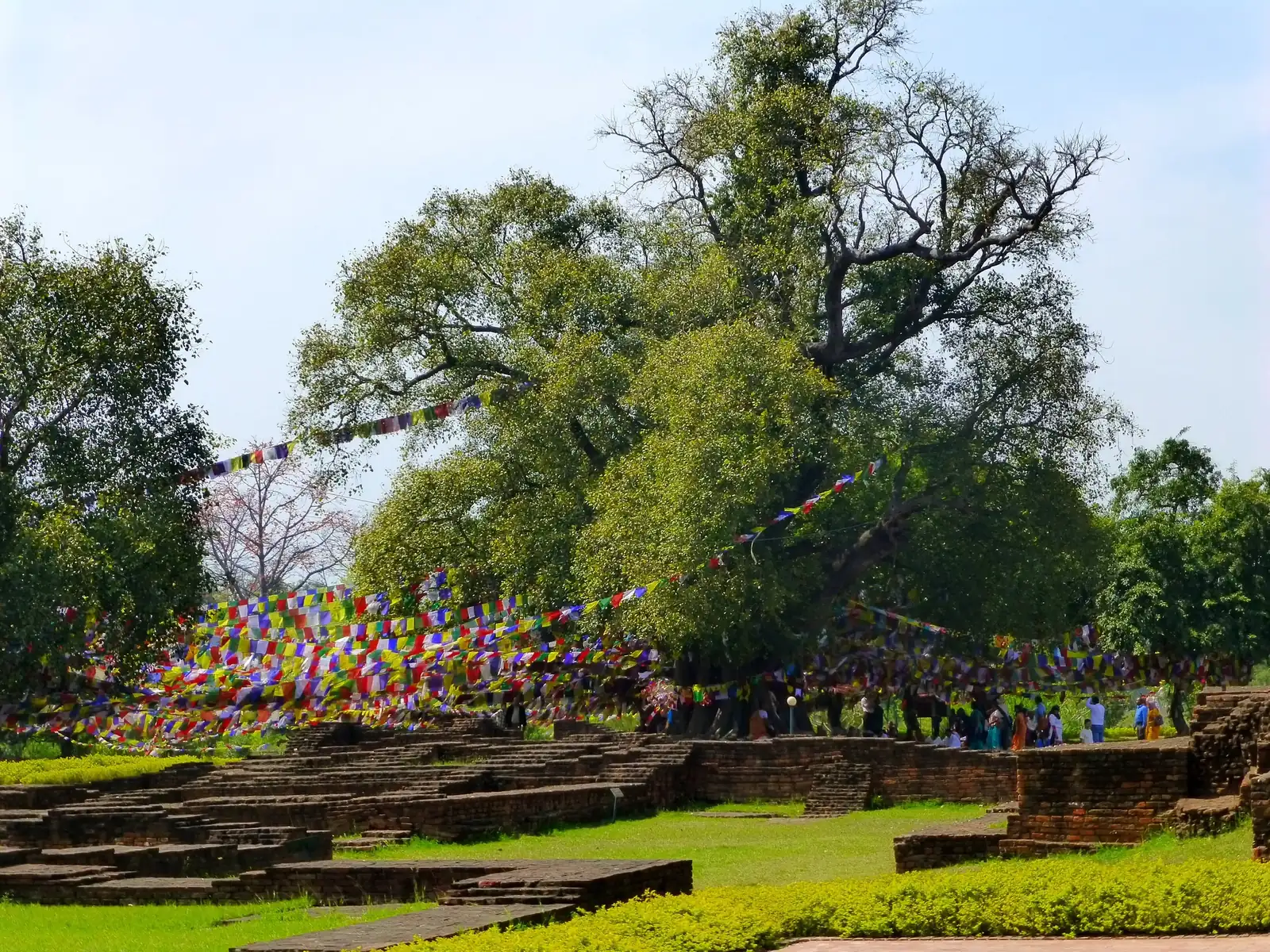
| Dhamma Jananī | Lumbini, Nepal | Mother of Dhamma |
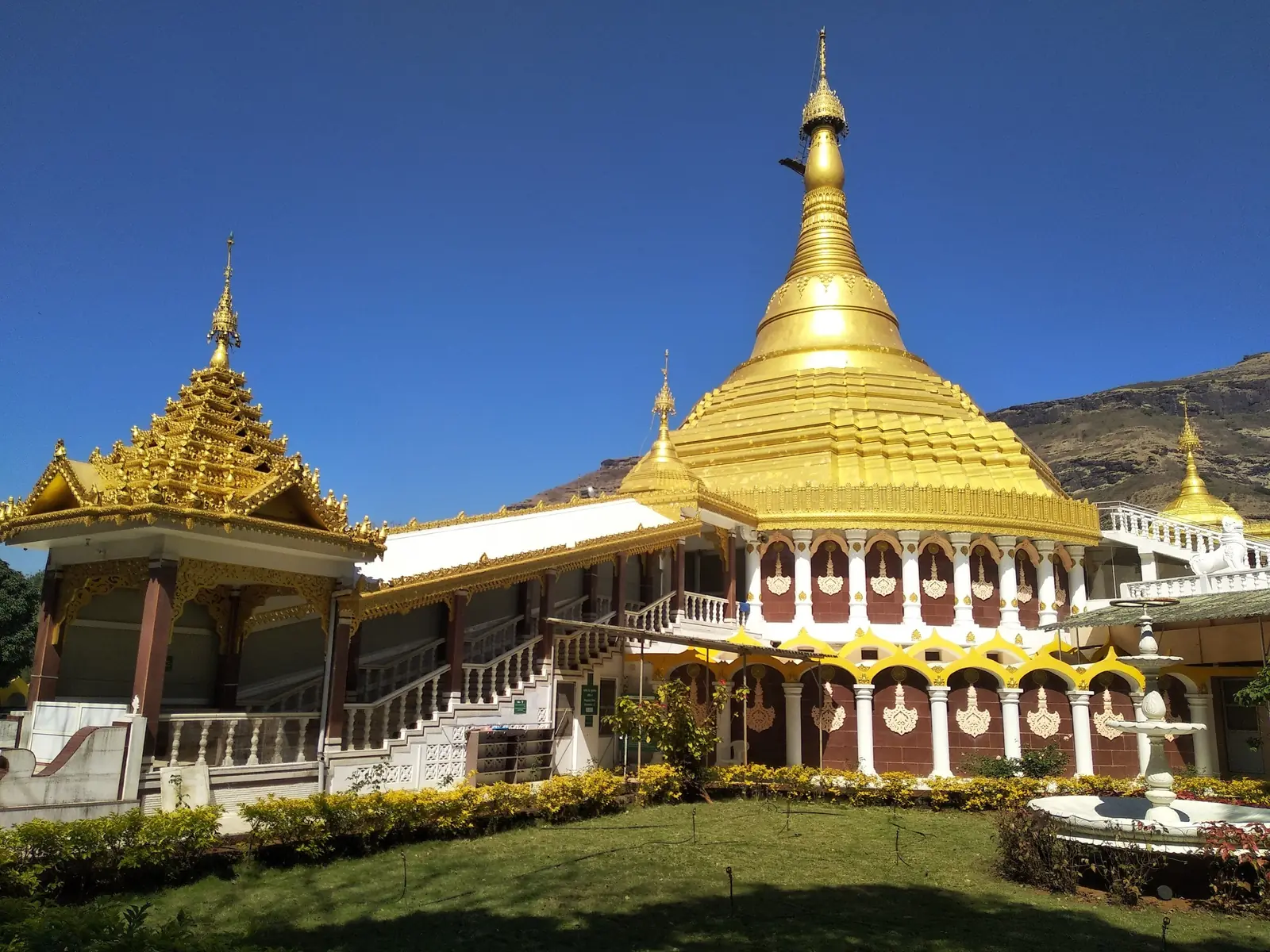
| Dhamma Giri | Igatpuri, India | Hill of Dhamma |
Goenka presented the Buddha's teaching as universal rather than sectarian. In an essay published on dhamma.org he wrote that the Buddha "never established or taught any religion, any 'ism'", and that suffering "is a universal malady which requires a universal remedy, not a sectarian one". Other Buddhist traditions describe the relation between Vipassana and Buddhism differently; what is Vipassana? sets their answers side by side.
How Buddhist Dhamma differs from Hindu dharma
It is the same word, but it carries different meanings in the two religions. Britannica summarises them this way:
| In Hinduism | In Buddhism | |
|---|---|---|
| Basic meaning | The religious and moral law governing individual conduct | The doctrine, "the universal truth common to all individuals at all times, proclaimed by the Buddha" |
| Other senses | One of the four ends of life; a dharma for everyone (truthfulness, non-injury, generosity), plus a specific dharma according to one's class, status and station in life | One of the Three Jewels; in the plural, the elements that make up the world as we experience it |
In Hinduism, Britannica adds, dharma is the subject of the Dharma-sutras and Dharma-shastras, the earliest sources of Hindu law.
Jainism uses the word for moral virtue and also, in a sense found only there, for an eternal substance that allows beings to move.
In Nepali and Hindi, धर्म can carry any of these meanings, or simply mean "religion". Dr B. R. Ambedkar gave the word a strongly social reading in his last book, where he wrote that "Dhamma is righteousness, which means right relations between man and man in all spheres of life". The Buddha and His Dhamma explains that book.
For the short definition, see dhamma in the glossary. To see how the teaching is organised as a path, continue with the three trainings.
Sources
- Pali-English Dictionary: dhamma, Pali Text Society, via Digital Dictionaries of South Asia
- Glossary of Pali and Buddhist Terms, Access to Insight
- Dharma (religious concept), Encyclopaedia Britannica
- Dīgha Nikāya 16: The Great Discourse on the Buddha's Extinguishment (trans. Bhikkhu Sujato), SuttaCentral
- Majjhima Nikāya 22: The Simile of the Snake (trans. Bhikkhu Sujato), SuttaCentral
- Majjhima Nikāya 10: Mindfulness Meditation (trans. Bhikkhu Sujato), SuttaCentral
- Aṅguttara Nikāya 6.10: With Mahānāma (trans. Bhikkhu Sujato), SuttaCentral
- Khuddakapāṭha 1: The Three Refuges (trans. Bhikkhu Sujato), SuttaCentral
- Dhammapada 1–20 and 273–289 (trans. Bhikkhu Sujato), SuttaCentral
- The Art of Living: Vipassana Meditation (S. N. Goenka), dhamma.org
- Course Glossary, dhamma.org
- The Discourse Summaries (S. N. Goenka, condensed by William Hart), Vipassana Research Institute