The Dhammapada: the Buddha's verses on the path, explained
The Dhammapada is a Pali collection of 423 verses attributed to the Buddha. What it contains, how it was compiled, famous verses and where to read it free.
Vipassana Nepal team · · 7 min read
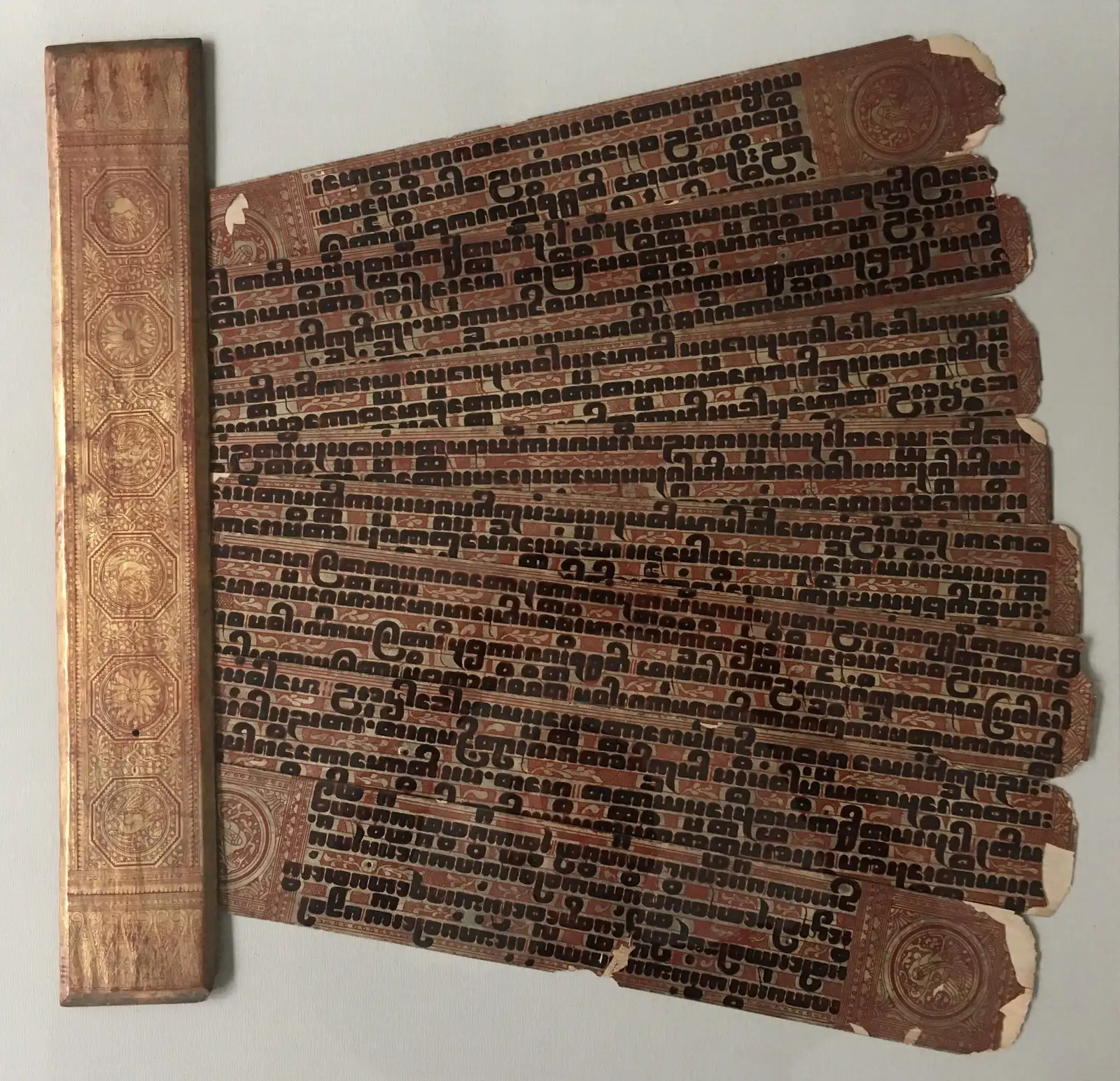
The Dhammapada is a collection of 423 short verses attributed to the Buddha, arranged in 26 chapters. It belongs to the Pali Canon, the scriptures of Theravāda Buddhism, and Britannica calls it "probably the best-known book in the Pali Buddhist canon": an anthology of basic teachings, mostly ethical, in short, memorable sayings. Several English translations are free to read online.
What the name Dhammapada means
The title joins two Pali words. Dhamma is the Buddha's teaching, and the truth it points to (what is Dhamma? explains the word). Pada has a wide range: the Pali Text Society's dictionary gives foot, step, track, and way or path. Translators choose different emphases: Bhikkhu Sujato calls the book Sayings of the Dhamma, Access to Insight's edition is titled The Path of Dhamma, and Acharya Buddharakkhita subtitled his translation The Buddha's Path of Wisdom.
People also write the name as two words, "Dhamma pada", or in its Sanskrit form, Dharmapada.
Where the Dhammapada sits in the Pali Canon
The Pali Canon, or Tipiṭaka, has three "baskets": the Vinaya (monastic discipline), the Suttas (discourses) and the Abhidhamma (systematic analysis). The Dhammapada is in the second basket, the Sutta Piṭaka. It is the second text of that basket's fifth division, the Khuddaka Nikāya or "Minor Collection".
How and when it was compiled
Buddhist tradition and modern scholars tell the story differently.
The Theravāda account. According to Theravāda tradition, as Buddharakkhita's preface sets it out, each verse was spoken by the Buddha in response to a particular event. Stories of those events, with explanations of the verses, are kept in the classic commentary to the Dhammapada, compiled by Buddhaghosa in the fifth century CE from much older material.
The scholarly account. Britannica describes the book as an anthology. More than half of its verses also appear in other texts of the canon, and others come from the store of short sayings shared by much of Indian literature. There is no firm date for the compilation. The Pali Canon as a whole was handed down orally and, as Bhikkhu Ñāṇamoli's introduction to The Path of Purification records, first written down in Sri Lanka in the first century BCE.
Other versions. The Pali Dhammapada is one of several related collections. Thanissaro Bhikkhu's historical notes list them:
- several recensions of the Pali text, from Myanmar, Cambodia, Laos, Sri Lanka and Thailand;
- two incomplete manuscripts of a Gāndhārī Dharmapada found in Central Asia;
- the Patna Dharmapada, a manuscript in Buddhist Hybrid Sanskrit found in Tibet, named after the city where photographs of it are kept;
- a Chinese translation made in the third century CE from a lost original in a Prakrit (an Indian vernacular language);
- the Udānavarga, in Sanskrit, Tibetan and Chinese versions, which shares many verses.
The versions order their verses differently and each has verses the others lack. Thanissaro judges the differences to range from "fairly minor to minor in the extreme", with none of them outside standard early Buddhist teaching.
The 26 chapters at a glance
Chapter titles below follow Bhikkhu Sujato's translation. Each chapter gathers verses on one theme or built around one image.
| Chapter | Pali name | English | Verses | Count |
|---|---|---|---|---|
| 1 | Yamakavagga | Pairs | 1–20 | 20 |
| 2 | Appamādavagga | Diligence | 21–32 | 12 |
| 3 | Cittavagga | The Mind | 33–43 | 11 |
| 4 | Pupphavagga | Flowers | 44–59 | 16 |
| 5 | Bālavagga | The Fool | 60–75 | 16 |
| 6 | Paṇḍitavagga | The Astute | 76–89 | 14 |
| 7 | Arahantavagga | The Perfected Ones | 90–99 | 10 |
| 8 | Sahassavagga | The Thousands | 100–115 | 16 |
| 9 | Pāpavagga | Wickedness | 116–128 | 13 |
| 10 | Daṇḍavagga | The Rod | 129–145 | 17 |
| 11 | Jarāvagga | Old Age | 146–156 | 11 |
| 12 | Attavagga | The Self | 157–166 | 10 |
| 13 | Lokavagga | The World | 167–178 | 12 |
| 14 | Buddhavagga | The Buddhas | 179–196 | 18 |
| 15 | Sukhavagga | Happiness | 197–208 | 12 |
| 16 | Piyavagga | The Beloved | 209–220 | 12 |
| 17 | Kodhavagga | Anger | 221–234 | 14 |
| 18 | Malavagga | Stains | 235–255 | 21 |
| 19 | Dhammaṭṭhavagga | The Just | 256–272 | 17 |
| 20 | Maggavagga | The Path | 273–289 | 17 |
| 21 | Pakiṇṇakavagga | Miscellaneous | 290–305 | 16 |
| 22 | Nirayavagga | Hell | 306–319 | 14 |
| 23 | Nāgavagga | Elephants | 320–333 | 14 |
| 24 | Taṇhāvagga | Craving | 334–359 | 26 |
| 25 | Bhikkhuvagga | Mendicants | 360–382 | 23 |
| 26 | Brāhmaṇavagga | Brahmins | 383–423 | 41 |
The last and longest chapter, "Brahmins", takes the name of the priestly class and gives it a new meaning. Verse 393 says: "Not by matted hair or family, / or birth is one a brahmin."
The best-known verses
All translations below are Bhikkhu Sujato's, which SuttaCentral publishes under a CC0 public-domain dedication. His English follows American spelling.
The mind comes first (verses 1 and 2)
The book opens with a pair. The Pali begins manopubbaṅgamā dhammā.
Intention is the leader of things;
intention is first, they're made by intention.
If with corrupt intent
you speak or act,
suffering follows you,
like a wheel, the ox's foot.
Verse 2 repeats the first two lines, then turns: "If with pure intent / you speak or act, / happiness follows you / like a shadow that never leaves."
Hatred and love (verse 5)
For never is hatred
laid to rest by hate,
it's laid to rest by love:
this is an ancient teaching.
The Pali ends esa dhammo sanantano: here dhamma means a lasting law or truth.
The teaching in one verse (verse 183)
Not to do any evil;
to embrace the good;
to purify one's mind:
this is the instruction of the Buddhas.
The three characteristics (verses 277 to 279)
Three verses in "The Path" repeat one pattern. All conditions are impermanent (sabbe saṅkhārā aniccā), all conditions are suffering, and all things are not-self (sabbe dhammā anattā). When each is "seen with wisdom, / one grows disillusioned with suffering: / this is the path to purity." These are the three characteristics that Vipassana practice sets out to see directly; impermanence, suffering and non-self explains them.
Why meditators read the Dhammapada
The verses are short and easy to remember, and several speak to meditators directly. Verse 276 puts the responsibility on the practitioner: "You yourselves must do the work, / the Realized Ones just show the way." Verse 282 links practice and understanding: "From meditation springs wisdom, / without meditation, wisdom ends." Chapter 3, "The Mind", describes the untrained mind as "hard to hold back, flighty" and says that "a tamed mind leads to bliss" (verse 35).
For how ethics, meditation and wisdom fit together in the Buddha's teaching, see the three trainings. The verses have also been reused in new settings: the section on "the Buddhist way of life" in Dr B. R. Ambedkar's last book consists almost entirely of Dhammapada verses, according to the Buddhist writer Sangharakshita. See The Buddha and His Dhamma.
Reading is not a substitute for practice with a teacher. The traditions that teach Vipassana do so on residential courses; the centres directory lists where.
Where to read the Dhammapada free online
Verse numbers are the same in all these editions, so you can compare translations verse by verse.
| Translation | Where | Terms of use |
|---|---|---|
| Bhikkhu Sujato, Sayings of the Dhamma | SuttaCentral, with the Pali alongside | CC0 (public domain) |
| Thanissaro Bhikkhu, The Dhammapada: A Translation (1997) | Access to Insight, with historical and end notes; also as a free PDF | Creative Commons BY-NC 4.0, as shown on the page |
| Acharya Buddharakkhita, The Buddha's Path of Wisdom (Buddhist Publication Society, 1985) | Access to Insight, with an introduction by Bhikkhu Bodhi | Free distribution under the publisher's terms |
Access to Insight's Dhammapada index links Buddharakkhita's and Thanissaro's versions chapter by chapter. For the word at the centre of the title, read what is Dhamma?.
Sources
- Dhammapada, Encyclopaedia Britannica
- Sayings of the Dhamma (Dhammapada), trans. Bhikkhu Sujato, SuttaCentral
- Dhammapada 1–20: Pairs (trans. Bhikkhu Sujato), SuttaCentral
- Dhammapada 179–196: The Buddhas (trans. Bhikkhu Sujato), SuttaCentral
- Dhammapada 273–289: The Path (trans. Bhikkhu Sujato), SuttaCentral
- Bilara data: licensing of SuttaCentral translations (CC0), SuttaCentral
- Dhammapada: The Path of Dhamma (index of translations), Access to Insight
- The Dhammapada: A Translation, with Historical Notes (Thanissaro Bhikkhu, 1997), Access to Insight
- The Dhammapada: The Buddha's Path of Wisdom (trans. Acharya Buddharakkhita, BPS 1985), Access to Insight
- Ambedkar and Buddhism (Sangharakshita, Windhorse 1986), chapter 8, Windhorse Publications
- Dhammapada 33–43: The Mind (trans. Bhikkhu Sujato), SuttaCentral
- Dhammapada 383–423: Brahmins (trans. Bhikkhu Sujato), SuttaCentral
- The Path of Purification, translator's introduction (Bhikkhu Ñāṇamoli), Buddhist Publication Society, via Access to Insight
- Pali-English Dictionary: pada, Pali Text Society, via Digital Dictionaries of South Asia