
Loading…
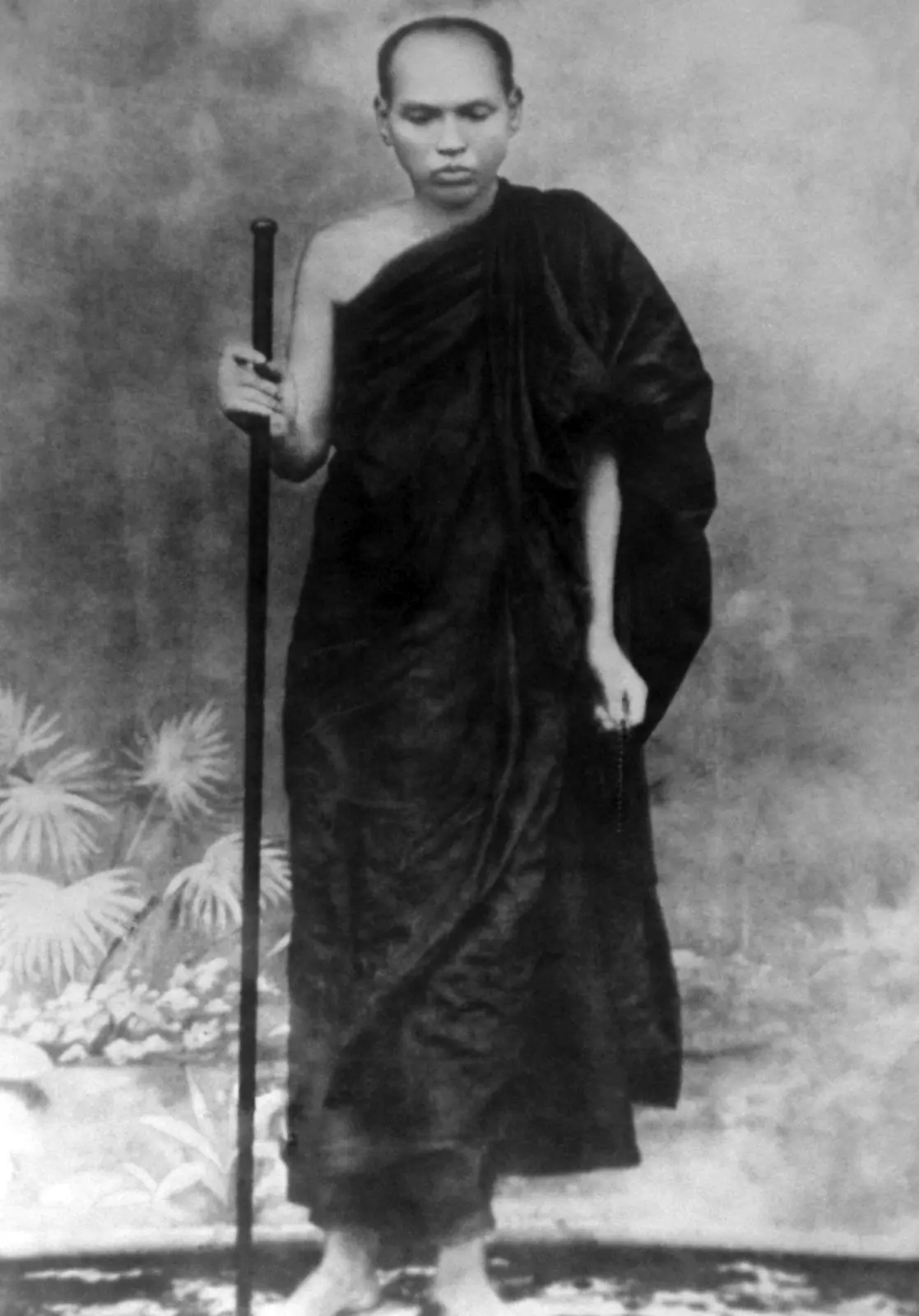 Photo: Unknown author, Public domain
Goenka (U Ba Khin) · 1846–1923
Burmese monk-scholar who wrote Dhamma for ordinary readers and opened Vipassana practice to lay people.
Ledi Sayadaw was a Burmese monk and scholar whose books and teaching helped turn insight meditation into a practice for lay people as well as monks. S. N. Goenka's courses and the International Meditation Centres both trace their line of teachers back to him, through the farmer Saya Thetgyi and the civil servant Sayagyi U Ba Khin.
He was born in 1846 in Saing-pyin village, in Dipeyin township of what was then Shwebo district (now Monywa district), Upper Burma. His childhood name was Maung Tet Khaung. At 15 he became a novice under U Nanda-dhaja, his first teacher, who gave him the monastic name Ñāṇa-dhaja, "banner of knowledge". He took full ordination as a bhikkhu on 20 April 1866 (Vipassana Research Institute, VRI).
He went on to study at the Maha-Jotikarama monastery in Mandalay, known as San-Kyaung. During the Fifth Buddhist Council, held at Mandalay in 1871 under King Mindon, he helped edit and translate the Abhidhamma texts (VRI). That council had the whole Tipiṭaka carved on 729 marble slabs (tipitaka.org).
VRI records that his teacher San-Kyaung Sayadaw once set twenty examination questions for some 2,000 students. Only the young Ñāṇa-dhaja answered all twenty. His answers were published in 1880 as the Parami-Dipani.
From 1882 he taught in Monywa by day and meditated at night on Lak-pan-taung hill. In the mid-1880s he withdrew to the Ledi forest north of Monywa. Monks came to study with him there, a monastery called Ledi-tawya grew up, and the forest gave him the name by which he is known (VRI).
According to VRI, he wanted to write in Burmese "in such a way that even a simple farmer could understand". His works range from Abhidhamma manuals and a Pali grammar to a book of some 2,000 verses and a pamphlet against the killing of cattle. Several of his manuals were later translated and collected in English as The Manuals of Dhamma.
In 1911 the British government of India gave him the title Aggamahāpaṇḍita. From 1913 to 1917 he corresponded with Mrs Rhys Davids of the Pali Text Society (VRI).
Spirit Rock Meditation Center calls him "the first Burmese monastic in our modern lineage". It says he taught that anyone could reach the first stages of liberation by paying mindful attention to ordinary sense experience, without first developing the deep absorptions (jhāna).
The historian Erik Braun argues that Burmese Buddhists of the colonial period "were pioneers in making insight meditation indispensable to modern Buddhism". In his account, Ledi, by spreading the study of Abhidhamma texts, "was able to standardize and simplify meditation methods and make them widely accessible", partly to protect Buddhism in Burma after the British took over in 1885 (University of Chicago Press).
The student who carried his meditation teaching forward was a rice farmer from Pyawbwegyi, near Yangon, known as Saya Thetgyi. Around 1915, VRI says, Ledi Sayadaw gave him his own staff and asked him to teach the Dhamma of rūpa and nāma (matter and mind) to 6,000 people. Ledi also had him instruct about 25 monks at the monastery, telling them that this layman "is capable of teaching meditation like me".
Spirit Rock puts the importance of this plainly: the revival Ledi began "continued not through a monastic successor, but through a brilliant lay disciple".
He went blind at 73 and spent his last years meditating and teaching meditation. He died at Pyinmana in 1923, aged 77 (VRI).
Saya Thetgyi taught Sayagyi U Ba Khin, who designed the ten-day residential course. U Ba Khin's students carried the teaching in two directions: S. N. Goenka founded the worldwide network described under Vipassana as taught by S. N. Goenka, and Mother Sayamagyi led the International Meditation Centres. How the Burmese revival fits into the longer history is told in How Vipassana survived.
1873–1945 · Myanmar
Rice farmer who became one of Burma's first lay Vipassana teachers and taught Sayagyi U Ba Khin.
1899–1971 · Myanmar
Accountant General of Burma and lay teacher who designed the ten-day Vipassana course and taught S. N. Goenka.
1924–2013 · Myanmar / India
Burmese-born Indian teacher who took U Ba Khin's Vipassana to India in 1969 and spread free ten-day courses.