How to start Vipassana meditation: first steps for beginners
Vipassana is learned on a residential course. How beginners can start now with breath awareness and walking, then choose and book a first course.
Vipassana Nepal team · · 6 min read
To start Vipassana meditation, begin a short daily sit of breath awareness at home, then book a first residential course with a teacher. The Vipassana technique itself is taught in person on such a course, and no article or video can stand in for that. Breath awareness is different: teachers of several traditions publish simple instructions for beginners, and in S. N. Goenka's tradition the first course is a free 10-day course.
This guide covers both parts: what to practise at home now, and how to choose and book a course. It also lists the mistakes beginners most often make.
Can you learn Vipassana at home?
Not the full technique, according to the traditions that teach it. Courses in S. N. Goenka's tradition call the 10-day course "the minimum", because, dhamma.org says, in less time "the student does not get a sufficient experiential grasp of the technique". The Mahasi and Western insight meditation traditions also teach mainly through retreats, where students talk regularly with a teacher.
There are good reasons for this. A teacher can answer questions as they come up, and an intensive retreat can bring up difficult experiences that are easier to handle with support (see difficult experiences on meditation retreats). So this page does not teach any tradition's Vipassana method. It describes the preparation that teachers themselves offer to anyone.
First steps you can take at home
Breath awareness, ānāpāna in Pali, is the usual starting point. It is the first practice on Goenka courses, and Spirit Rock Meditation Center's published introduction also begins with the breath. The steps below summarise that published guidance.
1. Find a quiet time and place
Spirit Rock's introduction, adapted from Jack Kornfield, begins: "select a quiet time and place".
2. Sit upright but relaxed
Sit on a cushion or a chair in what Spirit Rock calls "an erect yet relaxed posture", and close your eyes gently. You do not need to sit cross-legged. Even on Goenka's courses, chairs are provided for anyone who cannot sit comfortably on the floor.
3. Let the breath be natural
Do not try to breathe in any special way. Ajahn Chah, the Thai forest teacher, warned that forcing the breath to be long or short makes the mind unbalanced: "We don't get concerned over how long or short, weak or strong it is, we just note it." Spirit Rock puts it as: "Let the breath breathe itself."
4. Rest attention where you feel the breath
Spirit Rock suggests wherever you notice it most: coolness or tingling at the nose or throat, or the rise and fall of the chest or abdomen. Ajahn Chah narrowed attention to the nose-tip or the upper lip, "where the air passes on its in and out passage". Traditions differ here, and the Ānāpāna page compares them.
5. When the mind wanders, come back
Spirit Rock notes that after a few breaths your attention may be carried away. That is not a mistake. The same guide suggests noticing what carried you away, giving it a soft name such as "planning" or "remembering", and gently returning to the breath. Naming what happens is a feature of some traditions: Mahasi Sayadaw's instructions note a wandering mind as "wandering, wandering", while other teachers simply come back to the breath.
6. Decide how long, and stop gently
Spirit Rock's guide suggests sitting "for 20 or 30 minutes", then opening your eyes and looking around before you get up. Set the length before you start, so you are not checking the clock. The meditation timer on this site rings a bell to start and end a sit.
7. Add walking meditation
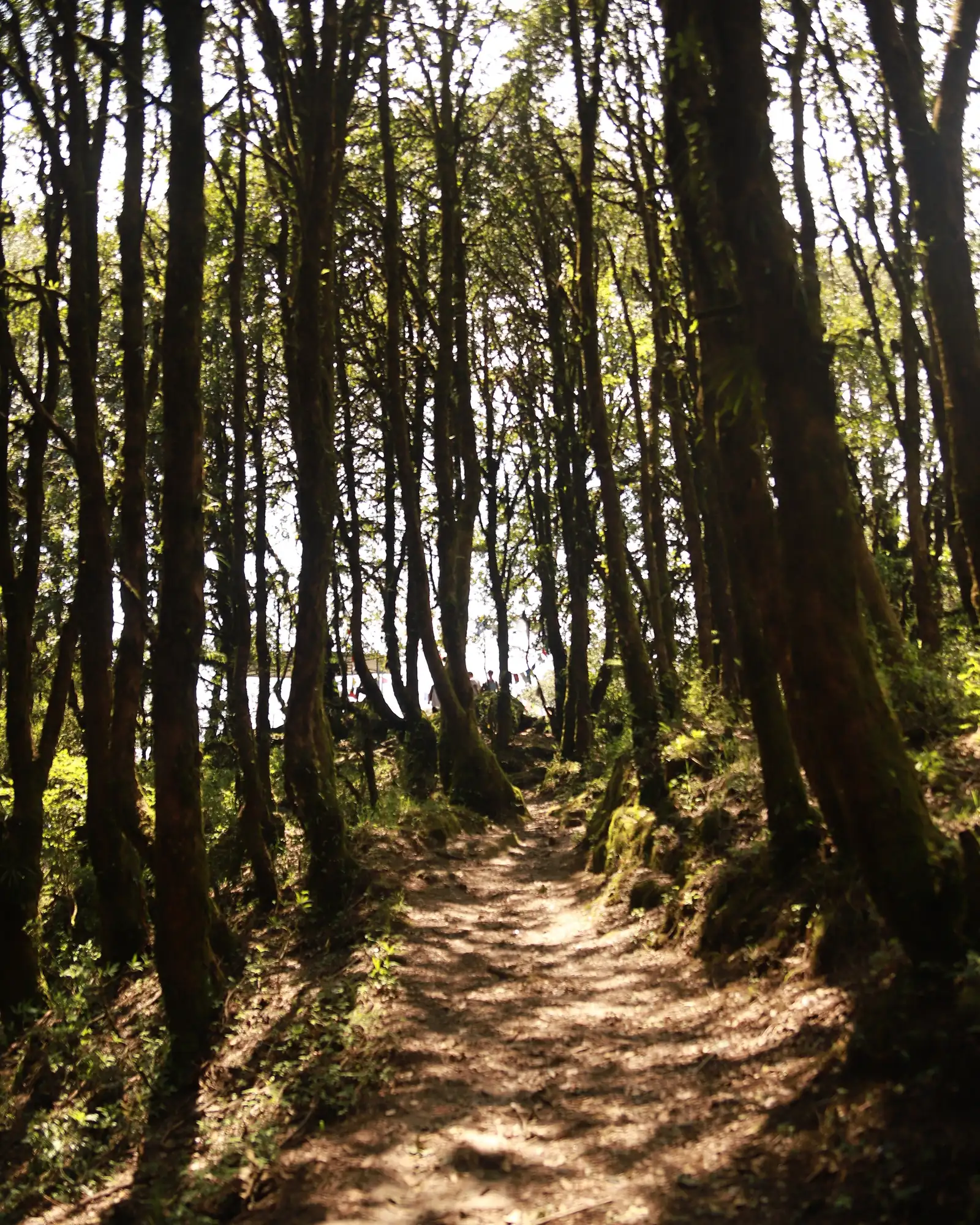
Walking meditation is practised in the Mahasi and Thai forest traditions, among others, and Ajahn Nyanadhammo, a Thai forest teacher, says it helps against drowsiness. He suggests that beginners use a path of about fifteen paces, decide beforehand how long to walk, keep the eyes cast down about a metre and a half ahead, and keep awareness "on the feeling at the soles of the feet". At the end of the path, turn slowly and check where the mind is. More detail is on the walking meditation page.
A guided option from Goenka's tradition
Goenka's organisation publishes a short Mini-Anapana recording of breath awareness, in his voice and in many languages, on discourses.dhamma.org. Its guidelines ask that you sit with your back straight and in silence, and that no one adds instructions of their own. It is free, and it does not count as a course: listeners are not "old students" and cannot join courses reserved for them.
What happens on a course
On a Goenka course, dhamma.org describes three steps. Students first keep five moral precepts, called sīla, for the length of the course. They then spend the first days on breath awareness to calm and focus the mind. From the fourth day they practise Vipassana itself, observing sensations throughout the body with equanimity. On the last full day they learn mettā, goodwill towards all. The method is taught step by step by the teacher on the course, and this site describes it without teaching it. A day-by-day account is in the 10-day course.
Other traditions start differently. Mahasi Sayadaw's own instructions start with noting the "rising" and "falling" of the abdomen, alternating with walking meditation. The comparison of traditions sets out how they differ.
How to choose your first course
Three questions narrow it down:
- Which tradition? Read the techniques pages and pick the approach that makes sense to you. There is no single right answer, and the site does not rank them.
- Where? The centre directory lists centres by country, including Nepal and India. Each centre page links to its official schedule.
- How long? In Goenka's tradition every beginner starts with a 10-day course. Other traditions offer shorter retreats; check with the centre.
How to book a course
- Read the rules first. Goenka courses ask you to keep silence, stay the whole course and follow the timetable. dhamma.org publishes the full code of discipline.
- Set aside the time. A 10-day course spans 12 calendar days, including the day you arrive and the day you leave.
- Apply through the official site of the centre or organisation. Goenka courses have no fee for teaching, food or lodging and run on donations from past students.
- Answer the health questions honestly. dhamma.org asks applicants to tell the organisers about their mental health history, and says that for overwhelming depression, anxiety, panic or PTSD "the best thing may be to work with a health professional".
- Prepare. Before your first course covers what to pack and how to get ready.
Common beginner mistakes
- Controlling the breath. The instruction in these traditions is to watch the natural breath, not to breathe deeply or slowly on purpose.
- Treating a wandering mind as failure. Noticing and coming back is the practice. Spirit Rock's guide says some sittings will feel settled and others busy, and that "either way is fine".
- Teaching yourself a course method from videos. Goenka's tradition asks that its Vipassana be learned on a course, and its Mini-Anapana guidelines ask that no other instructions be mixed in. Learn a method from the people who teach it.
- Expecting a cure. dhamma.org says "the purpose of Vipassana is not to cure illness". Speak to a doctor about health problems.
- Choosing an intensive retreat at a hard time. The Insight Meditation Society says a silent retreat may not suit someone with recent trauma, significant depression or anxiety, or strong PTSD. In that case daily practice may help more in the meantime.
- Leaving a course early. Each day builds on the one before, so dhamma.org asks students to stay for the whole course. Check the dates before you apply.
When you are ready, find a centre near you in the Vipassana centre directory.
Sources
- Introduction to Insight Meditation (Jack Kornfield and Gil Fronsdal), Spirit Rock Meditation Center
- On Meditation (Ajahn Chah), ajahnchah.org
- Walking Meditation (Ajahn Nyanadhammo, Wat Pah Nanachat, 2003), Abhayagiri Buddhist Monastery
- Mini Anapana recordings and guidelines, dhamma.org
- Online Anapana, Dhamma Muttā, Hong Kong Vipassana Meditation Centre
- Vipassana Meditation, dhamma.org
- Questions & Answers About the Technique of Vipassana Meditation, dhamma.org
- Introduction to the Technique and Code of Discipline, dhamma.org
- Satipatthana Vipassana (Mahasi Sayadaw), Access to Insight
- FAQs About Retreats, Insight Meditation Society