
Loading…
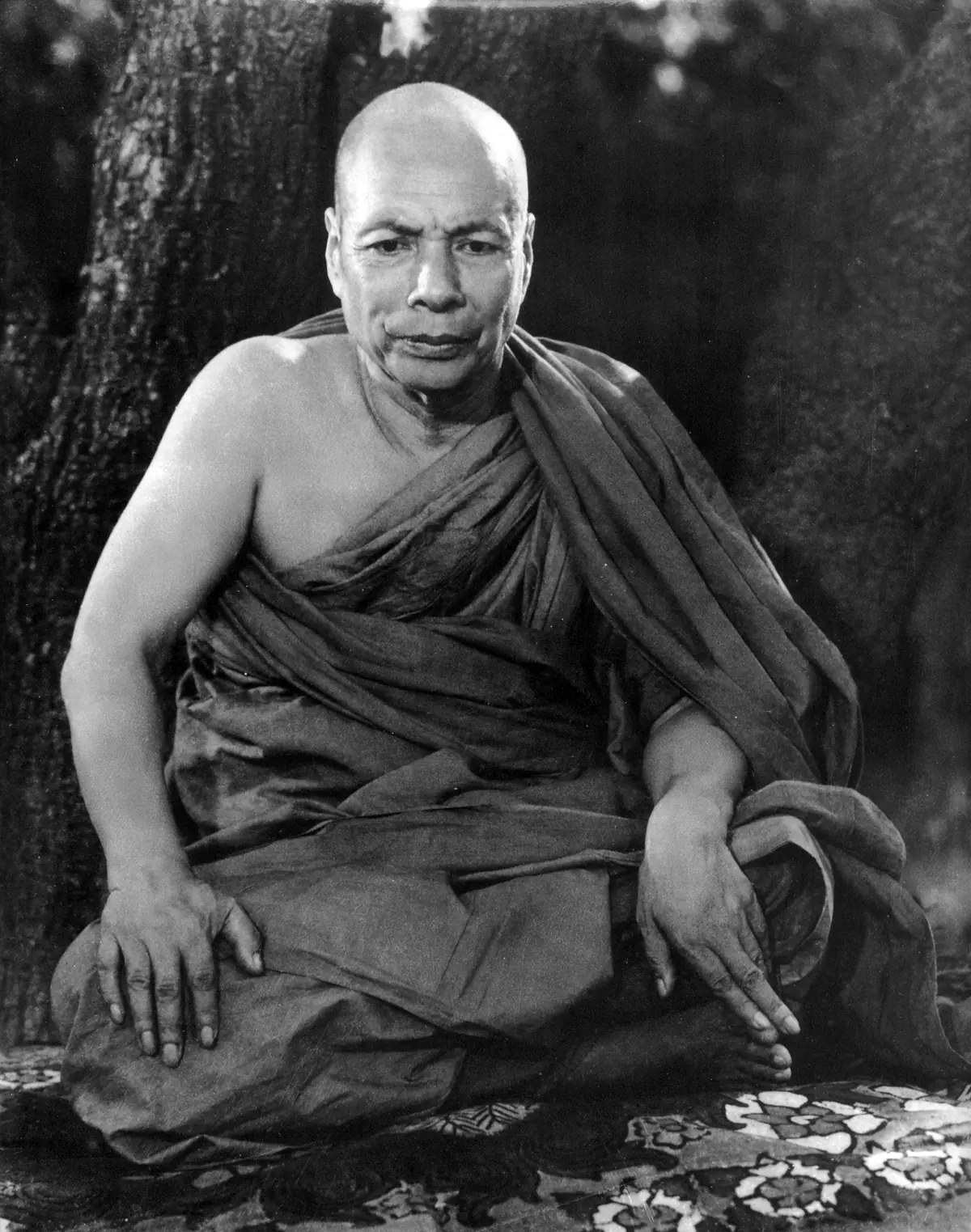 Photo: Unknown author, Public domain
Mogok · 1899–1962
Burmese Abhidhamma teacher whose insight method centres on dependent origination, feeling and mind.
Mogok Sayadaw, U Vimala, was a Burmese monk who spent the first half of his career as a teacher of Abhidhamma, the analytical texts of the Pali Canon, and the second half teaching insight meditation. His method asks the meditator to understand dependent origination (paṭicca-samuppāda) and then to watch feeling and mind arise and pass away. His talks were recorded, and Mogok groups still practise by listening to them.
He was born on 27 December 1899 in U Yin Daw village, Amarapura township, not far from Mandalay (Uttamo). His biography, translated in excerpts by Jenny Ko Gyi, gives the year as 1261 in the Burmese calendar and names his parents as U Aung Tun and Daw Shwe Eik; he was the fifth of their eight children, and his childhood name was Maung Hla Baw.
As a boy he became a novice at the forest monastery in his village under Sayadaw U Jagara, who gave him the name Vimala, meaning free from defilements. At fourteen, against his parents' wishes, he left for the Maṅgala monastery in Amarapura, then crowded with monks who came from across Burma to study Abhidhamma. There he was trained by Sayagyi U Ohn, a former monk and noted Abhidhamma teacher. He was fully ordained in 1919, with Bhaddanta Sujata of Maṅgala monastery as his preceptor (Uttamo; biography).
He began teaching Abhidhamma to monks in 1922 and soon had more students than the monastery could house. At about 28 he wrote a commentary on the Yamaka, the sixth book of the Abhidhamma. According to both biographies, an older monk and mentor, U Nāgavaṃsa, warned him that teaching and giving talks brought only merit, and that he needed to practise for himself. From then on he set aside time, often after midnight, for meditation.
Among those who studied with him were nuns from Mogok, the ruby-mining town in northern Burma. Through them, lay supporters from Mogok came to know him, and from 1934 they invited him to give talks there every year. They built monastic buildings and other gifts for him not only in Mogok but wherever he taught, and people began calling him the Mogok Sayadaw (Uttamo; biography). He also gave yearly talks at Nyaung-lay-bin, a series earlier given by Ledi Sayadaw or his disciples.
When the Second World War reached Burma, his supporters brought him to Mogok in March 1942, and in June he moved to a cave near Baw-pa-tan village, about four miles from the town. Bhikkhu Uttamo's account says he stayed there, practising, for four years. He came out after the rains retreat of 1945, and from then on he taught insight practice rather than Abhidhamma alone.
He returned to Amarapura in November 1952, and in the following years divided each year between Amarapura, Mandalay and Mogok. His disciples began recording his talks in 1954, and after his death some were transcribed into 33 volumes (Uttamo). To explain dependent origination he first laid out twelve betel nuts on a table, one for each link; later, with a disciple who ran a design company, this became a circular chart of the twelve links, which spread widely (Uttamo). A booklet by U Candavarabhivamsa of the Mogok Yeiktha in Yangon sets out the same cycle in English.
The Mogok approach puts understanding first. In Bhikkhu Uttamo's translation, the Sayadaw says:
Contemplation without any knowledge beforehand is impossible.
The objects he stressed were feeling (vedanā) and mind (citta): "To give up wrong view should contemplate the mind; and for craving contemplate feeling." He allowed mindfulness of breathing to calm a restless mind first, before turning to whatever feeling arises. The method is described further in The Mogok method, and the teaching behind it in Impermanence, suffering and non-self.
He died on 17 October 1962, the 4th waning day of Thadingyut, 1324 in the Burmese calendar, on the day of a kaṭhina robe-offering ceremony (biography). His biography records that he told close disciples to listen to his recorded talks again and again. Wikipedia, citing the scholar Kate Crosby, puts the number of Mogok meditation centres in Myanmar at over 300. English readers can now follow the talks in Bhikkhu Uttamo's 2024 translation, made from the original tapes.